






Anyone who thinks fashion is a modern invention is mistaken by millennia. In ancient Greece, clothing was far more than just protection from the weather: at a glance, it revealed a person’s status – free or slave, rich or poor, married or unmarried, citizen or stranger. And all this without a single complicated cut. The chiton, peplos and himation – three rectangular panels of fabric that, through masterful draping, became the epitome of timeless elegance. This article explores what Greek clothing really looked like, what it signified, and why haute couture designers continue to draw inspiration from it to this day.

What to expect in this article
- Key points at a glance
- Fashion in Ancient Greece – an introduction
- The chiton – the Greeks’ basic garment
- The peplos – the traditional women’s dress
- Himation and chlamys – coats and cloaks
- Materials, colours and manufacture
- Embellishments and Accessories
- Clothing, gender and social status
- Clothing in rituals, festivals and war
- Influence on Rome and later fashion history
- Frequently asked questions about clothing in ancient Greece
 Reading time approx. 12 mins.
Key points at a glance
- The chiton was the universal basic garment of the Greeks – men wore knee-length versions, whilst women wore floor-length versions made of wool or linen.
- The peplos was regarded as the traditional women’s dress of the 7th to 5th centuries BC, recognisable by its characteristic fold (apoptygma) at chest height.
- The himation served as a versatile woollen cloak, which was artfully draped and, for philosophers such as Socrates, symbolised learning and dignity as the sole garment.
- Greek clothing consisted of rectangular panels of fabric without complicated cuts – elegance was achieved solely through the folds and drapery.
- Materials, colours and embellishments made social status recognisable at a glance: purple for the elite, natural-coloured wool for everyday wear.
Fashion in Ancient Greece – an introduction
The clothing culture of ancient Greece spanned the Archaic to the Classical periods, roughly 800 to 323 BC. Unlike modern tailoring, it was based on just a few basic forms: the chiton, peplos, himation and chlamys. Their elegance stemmed not from form-fitting cuts, but from masterful draping, meticulous pleating and carefully chosen accessories – an art form that required years of practice and established social prestige.
Our most important sources are vase paintings from Athens – more than 100,000 largely complete vessels with figurative paintings have survived – as well as wall paintings and sculptures such as the famous Kore statues of the Acropolis, which depict the garments in surprising detail. Even today, the Greek art of drapery continues to inspire haute couture: contemporary asymmetrical evening dresses and flowing gowns have their roots on the Acropolis.
The chiton – the basic garment of the Greeks

The chiton formed the basis of the Greek wardrobe for men and women alike. This shirt-like garment consisted of two rectangular panels of fabric, fastened at the shoulders and sides with brooches, pins or seams – simple in its basic form, yet offering endless variations in design. Depending on the region, material and occasion, this gave rise to garments ranging from simple functionality to festive splendour.
A comparison of the Doric and Ionic chiton
| Feature | Doric chiton | Ionic chiton |
|---|---|---|
| Material | Heavy wool | Light linen |
| Origins | From the 7th century BC | From the 6th/5th century BC |
| Distribution | Mainland Greece | Ionian cities (e.g. Miletus) |
| Style | Simple, often with one open side | Richly pleated, flowing |
Men usually wore knee-length chitons – practical for sporting activities and everyday life in the agora. Women preferred floor-length versions reaching down to the ankles, an expression of modesty and domestic virtue. A belt worn at the waist or hips gave the garment additional shape and silhouette – and, by pulling the fabric up over the belt, created a practical pouch for small items, known as a kolpos.
Variations of the chiton in everyday life
Farmers, craftsmen and slaves wore simplified forms of clothing that prioritised freedom of movement over aesthetics. The exomis – a one-shouldered, short chiton – allowed maximum freedom of movement during physical labour: the bare shoulder prevented any restrictions when lifting and working. Athletes in the palaestra often trained almost naked or wearing only a perizom (loincloth) – physicality and athleticism were regarded as virtues in Greek society, not as a cause for shame. In contrast, wealthy citizens would appear at festivals in finely pleated, light-coloured linen chitons reaching down to the ankles. The differences between Ionic elegance and Doric simplicity reflected regional identities and cultural pride.
The peplos – the traditional women’s garment
The peplos dominated women’s fashion from the 7th to the 5th century BC. This heavy woollen garment consisted of a single large rectangle, which was draped over the body and fastened at both shoulders with bronze or iron brooches. A characteristic and distinctive feature was the apoptygma – a turned-up upper edge that hung down at chest height, lending the garment extra fullness and volume. A belt at the waist held everything in place and created the typical, upright silhouette familiar to us from Archaic sculptures.
Black-figure pottery from Athens depicts numerous examples of the peplos, often worn by goddesses such as Hera or noblewomen during ritual acts – the peplos was a garment of dignity, weight and significance.
Symbolism and Occasions for Wearing the Peplos
The peplos was considered particularly ‘honourable’ for married women on festive occasions. The best-known example in Greek history: At the Panathenaic Festival in Athens, an intricately woven peplos was dedicated to the city’s goddess, Athena, every four years – a masterpiece of wool, colour and political symbolism, the elaborately illustrated ceremonial version of which took the women of Athens around nine months to weave. The simpler everyday peplos, made of natural-coloured wool, differed markedly from the richly decorated, colourfully patterned ceremonial peplos. From the 5th century BC onwards, the lighter Ionian chiton came into fashion and gradually replaced the heavy woollen peplos for many women.

Himation and chlamys – coats and cloaks
A cloak was often worn over the chiton or peplos – to protect against the cold, but also as a deliberate status symbol. The himation was a large, rectangular woollen cloth, approximately 3 to 5 metres long and 1.5 to 2 metres wide according to various accounts, which was artfully draped around the shoulders and body. The typical way of wearing it left the right shoulder free for gesturing – indispensable in a culture where public speaking and public appearances were central civic duties. Philosophers such as Socrates are often depicted in ancient art wearing nothing but the himation – a deliberate symbol of intellectual dignity and sophrosyne (self-control, moderation). Those who could drape the himation masterfully demonstrated both their education and their poise.
A comparison of Greek cloak types
| Type of cloak | Use | Typical wearers |
|---|---|---|
| Himation | Everyday wear, public appearances, philosophy | Men and women |
| Chlamys | Travel, war, horse riding | Young people, soldiers, horsemen |
The chlamys, a shorter and lighter cloak dating from the 5th century BC, was fastened over one shoulder with a fibula and, if required, left the body completely exposed. It was ideal for riding and marching and was a real status symbol amongst young men in the Agora – the chlamys worn by soldiers and that worn by fashion-conscious citizens differed primarily in terms of fabric and workmanship.
Materials, colours and production

Textile production was firmly rooted in domestic life and was regarded as one of the most distinguished activities of a Greek housewife. Women spun wool on drop spindles and wove on vertical weight looms – key tasks that took months to complete for each garment. Wool was by far the most commonly used material, as sheep were widespread throughout Greece and the fibres took dye well; linen made from flax was a popular alternative for lighter garments.
- Sheep’s wool: a robust material for everyday wear, warm, durable and widely available.
- Linen made from flax: for summery, flowing garments – cooler and more translucent than wool.
- Silk: a rare imported commodity from the East, generally only becoming available during the Hellenistic period and then accessible only to the absolute elite.
Everyday fabrics remained in their natural colours, white or cream. Elaborate dyes were used for the upper classes: yellow from saffron, red from madder, blue from woad, and scarlet from kermes scale insects. The dyeing process itself was a highly specialised craft with its own guilds and closely guarded recipes – a good red was expensive, whilst a poor-quality red would fade after just a few washes.
Purple derived from murex snails was the most expensive pigment in the ancient world. Depending on the estimate, a single gram of purple dye required between ten and twelve thousand snails and days of labour – which is why genuine purple was usually used only as decorative stripes or sewn-on hems. Anyone wearing a garment entirely in purple was demonstrating their wealth in a way that no piece of jewellery could have surpassed.
Embellishments and accessories
Trims, woven patterns and embroidery adorned festive clothing in particular. Fibulae made of bronze, silver or gold served as both functional and decorative elements – they fastened the chiton at the shoulders and, through their material, signalled the wearer’s wealth. Simple bronze brooches were part of everyday life, whilst elaborately decorated silver or gold brooches with engravings and inlays were jewellery in the truest sense. Bracelets, necklaces and earrings made of amber, glass and precious metals further emphasised one’s status. During the Hellenistic period, particularly complex hairstyles emerged, featuring elaborate braids and hairpins made of ivory or gold, which magnificently complemented the garments.
Clothing, Gender and Social Status
In ancient Greece, clothing conveyed precise signals about gender, age and social standing – like a silent yet universally understood system of symbols. Free men wore shorter, practical chitons and appeared at public events draped in a dignified himation. Women favoured floor-length robes, which symbolised modesty and domestic virtue. Children wore simplified, smaller versions – often unbelted and shorter, as they had not yet been categorised within the social hierarchies of the adult world.
- Upper class: fine fabrics, bold colours, precious jewellery made of precious metals, purple trimmings.
- Middle class: neat woollen robes, simple bronze brooches, modest jewellery.
- The poorer classes and slaves: coarse wool, hardly any decoration, natural colours, often just a single garment.

Clothing for rituals, festivals and war
Ritual clothing was subject to strict rules. White robes were mandatory for sacrificial ceremonies, as purity and flawlessness honoured the deity. Special festive robes adorned processions such as the Panathenaea. Priestesses and priests were distinguished from the rest of the congregation by particularly light-coloured, pure clothing and often special headdresses – their appearance marked the boundary between the human world and their divine mission.
Beneath their hoplite armour, soldiers wore short chitons or undergarments made of coarse linen, which absorbed sweat and prevented chafing from the metal parts. Vase paintings deliberately used clothing as a visual code: immortals often appear in translucent, particularly finely pleated robes, whilst mortals wear simpler garments – a distinction that every Greek viewer understood at a glance.
Influence on Rome and later fashion history

From the 3rd/2nd century BC onwards, the Romans adopted Greek clothing traditions on a grand scale. The Roman tunic closely resembles the chiton: rectangular panels of fabric, fastened at the shoulders and sides, with a belt at the waist. Greek draping and pleating techniques found their way into the Roman toga, palla and stola – Rome’s sartorial language would simply be unthinkable without Greece.
During the Hellenistic period, which began with the death of Alexander the Great in 323 BC, hybrid styles emerged featuring richer drapery and exotic fabrics from the Orient. And even today: modern evening gowns, bridal wear and high-fashion collections deliberately draw on ‘Greek drapery’. Throughout her career, Madame Grès drew direct inspiration from ancient Greek and Roman sculptures for her flowing ‘goddess’ dresses; her art of draping, in turn, influenced later greats such as Issey Miyake and Azzedine Alaïa, who translated this Greek-inspired design language into modern haute couture. The timeless elegance of uncut rectangles lives on in every flowing dress of the present day.
Frequently asked questions about clothing in ancient Greece
What did women typically wear in ancient Greece?
Greek women mainly wore floor-length chitons or peplos as their main garments, complemented by a himation as a cloak. These garments were held in place at the waist with belts and fastened at the shoulders with brooches. In everyday life, plain, natural-coloured fabrics predominated, whilst festive attire was richly decorated – with embroidery, coloured hems and precious jewellery such as bracelets and earrings.
Were there shoes and sandals in ancient Greece?
Simple leather sandals were the standard footwear for both men and women. Indoors and during the summer months, many people went barefoot – footwear was more a matter of protection than a fashion statement. For travel, hunting and war, sturdier footwear was available, such as the robust, often metal-studded krepides for soldiers and hunters, or the fur-lined embades – originally adopted from Thrace – for cold days.
Were the garments sewn or simply wrapped?
The basic form was always an uncut rectangle, held in place with brooches, belts and a few stitches. Later variations, such as the Ionic chiton, were more frequently sewn at the sides, yet draping remained the central design element. This differs fundamentally from modern, form-fitting fashion – and makes Greek clothing a highly developed art form in its own right.
What role did brooches play in Greek clothing?
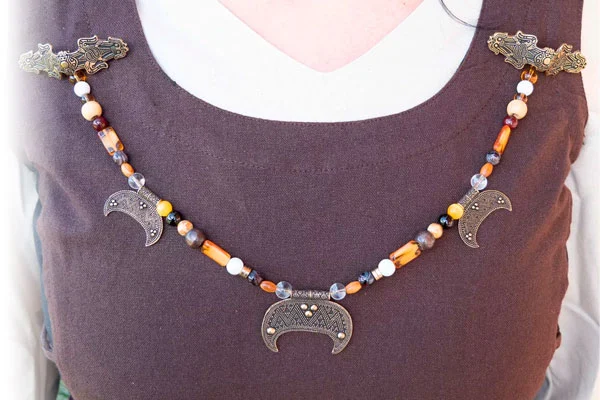
Brooches were indispensable: they held the chiton and peplos together at the shoulders and fastened cloaks such as the chlamys. Simple bronze bar-shaped brooches were part of everyday life for almost all social classes. Elaborately decorated brooches made of silver or gold, featuring engraved motifs and inlays of amber or coloured glass, were, by contrast, genuine pieces of jewellery and status symbols. For re-enactors and living history enthusiasts, historically accurate brooches remain an important part of authentic attire to this day – the shape of the brooch immediately reveals the era and social status of the person being portrayed.
How much did clothing cost, and how many outfits did people own back then?
Textiles were extremely labour-intensive – a garment could take weeks or even months to produce. Most people probably owned only a few complete outfits. Wealthy families possessed numerous festive garments. High-quality dyes such as purple and imported fabrics could increase the value of a garment many times over – a silk garment dyed entirely in purple was simply unaffordable for the vast majority of the population.
How do we know today what Greek clothing looked like?
Our knowledge comes from more than 100,000 surviving vase paintings, from sculptures such as the Kore statues on the Acropolis, and from rare textile finds from dry burial chambers. Written sources such as Herodotus and Aristophanes name specific garments and describe their social context. Modern reconstructions combine these sources with experimental archaeology – researchers sew and drape garments based on ancient models, thereby gaining a surprising number of practical insights into comfort, stability and suitability for everyday wear.
What is the difference between a chiton and a peplos?
Both are garments made from rectangular panels of fabric, but differ significantly in material, construction and period. The peplos was made of heavy woollen fabric and featured the characteristic apoptygma overlap at the chest – it was the older, traditional garment with a long symbolic history. The chiton was lighter, often made of linen, and could be transformed into a flowing, delicately pleated garment by fastening it at the shoulders with numerous brooches. From the 5th century BC onwards, the Ionic chiton supplanted the peplos among many women – a shift in fashion that was also a cultural shift.
How has Greek clothing influenced modern fashion?
Very directly, and its influence can still be felt today. Madame Grès drew her art of draping explicitly from ancient Greek and Roman models, and her Grecian silhouettes in turn inspired designers such as Issey Miyake and Azzedine Alaïa. The basic principle – fabric in its natural form, shaped by folds and draping rather than by cuts – recurs in every generation of haute couture. The classic one-shoulder evening gown, the flowing maxi skirt and asymmetrical gowns owe their elegance directly to the Greek tradition of dress. Anyone wearing a modern draped dress is wearing an echo of ancient Greece.


- Available
-
Delivery time: 3 - 5 working days* (GB - int. shipments may differ)


