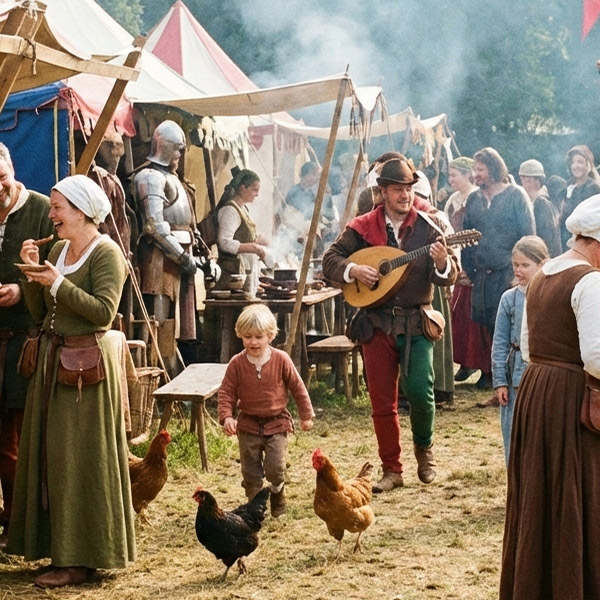
Medieval clothing and garments
Medieval attire is more than just a costume – it is a visible commitment to an era, a role and a way of life. Whether you’re planning your first medieval market, regularly take part in LARP or attend historical re-enactment events: in this category you’ll find attire for women, men and children – from simple beginner’s tunics to complete outfits made of wool and linen. Gambesons, dresses, shirts, doublets, tunics and headwear: here you’ll find everything you need for a period-appropriate outfit.
By era
 Ancient…–476
 Early Medieval500–1066
 High Medieval1050–1250
 Late Medieval1250–1500
 Renaissance1400–1600
Modern era
Renaissance1400–1600
Modern era
 Market-Medieval / Larptimeless
Ancient…–476
Early Medieval500–1066
High Medieval1050–1250
Late Medieval1250–1500
Renaissance1400–1600
Modern era
Market-Medieval / Larptimeless
3 departments, 22 subcategories
The range at a glance


Popular over the last 12 months
All items
In demand
Guide


 Medieval headwear
Capes & coats
Medieval headwear
Capes & coats
 Viking clothing for men
 Viking clothing for women
Medieval & Viking jewellery
Viking clothing for women
Medieval & Viking jewellery
 Medieval & Viking belts
 Medieval accessories
Medieval clothing & attire – for markets, LARP and re-enactment
What defines medieval clothing – material, cut and social status
Clothing in the Middle Ages was far more than just protection from the cold – it showed at a glance which social class a person belonged to. Colour, cut and fabric were strictly regulated within the rigid class system of the Middle Ages. Expensive dyes such as purple or scarlet were reserved for the nobility; commoners wore muted earth tones made from locally woven wool or linen. Fine embroidery, imported silk or elaborate trimmings signalled the wearer’s wealth.
As for wool and linen as basic materials: they were common across all social classes, but differed significantly in quality and workmanship. Coarse wool for the peasant, fine cloth for the nobility – this is historically documented and remains the basis for authentic costumes at living history events and medieval markets to this day. Those who value historical accuracy take their cue from these materials and avoid synthetic fibres, which simply did not exist in the Middle Ages.
Gambesons, armour vests and protective garments – clothing with a purpose
The gambeson is one of the most sought-after items of clothing in the field of medieval protective garments – and for good reason. Originally worn as padding beneath chainmail, it served as independent protection for ordinary foot soldiers who could not afford chainmail. Today, it is just as popular with LARP combatants as it is with re-enactors striving for a historically credible portrayal.
In our range, you’ll find gambesons such as the Donnergrund, the Greifenfels and the Rabenfurth – each made from a linen blend with padding, in colours such as natural, brown and black. These are complemented by neck guards and padded collars, as well as padded hoods that protect the head beneath the helmet. Those putting together a complete combat outfit combine the gambeson, padded collar and neck guard as a coordinated system. The Wolfenwacht armour tunic also belongs to this product group – a stylish garment with leather lacing that combines protection and aesthetics.
Costumes by period – Early Middle Ages, High Middle Ages, Late Middle Ages
Which garments are typical of which period? An overview of the three major eras helps in selecting the appropriate attire:
Early Middle Ages & Viking
6th–10th century
Simple tunics made of wool and linen, sturdy cloaks, plain leggings and calf wraps. Typical of Vikings, Franks and Anglo-Saxons. Viking attire features clean lines and natural fibres without elaborate embellishments.
High Middle Ages
11th–13th century
Distinctive cuts: tunics and surcoats for men, more elaborate women’s dresses with full skirts. Imported fabrics for the nobility, coarse wool in muted colours for the common people. Gambesons increasingly appear as protective clothing.
Late Middle Ages
14th–15th century
Tighter silhouettes, slits and embroidery. Houpelandes, surcoats and fitted dresses dominate the scene. Gambesons become more elaborate, with buttons and lacing becoming common fastenings.
The right outfit for your occasion – market, LARP or re-enactment
Depending on the event, the requirements for costume vary significantly. A visitor to a medieval market has different priorities to a living history re-enactor or a LARP player in a staged battle.
Starter · €30–80
A simple medieval shirt or dress for your first market visit or carnival. Cotton or linen in earth tones, comfortable fit, no historical accuracy required.
LARP & Fairs · €150–300
Complete outfit with shirt or dress, trousers, belt, bag, shoes and headwear. Sturdy materials for freedom of movement, gambeson for show fighters.
Reenactment · from €300
Multi-layered garments made of wool and linen, historically accurate cuts, no synthetic fibres. Undergarment, outer garment, surcoat or gambeson, plus matching footwear and headwear.
When putting together your outfit, we recommend a layer-by-layer approach: start with the undershirt or under-gown as the base layer, add a tunic, dress or gambeson as the top layer, and then complete the look with a belt, headwear, shoes and accessories. This allows you to build your outfit systematically – even across multiple purchases.
Medieval clothing for women, men and children
The range for women includes medieval dresses, skirts, blouses, Viking dresses and bodices in various styles and colours. From a simple tunic for a trip to the market to a multi-piece High Medieval dress made of wool – here you’ll find garments for every era and every occasion. Capes and cloaks for women also complete the range.
For men, the range includes shirts, tunics, doublets, trousers and gambesons. Whether a simple linen shirt for the market, a sturdy gambeson for LARP combat or a full re-enactment outfit made of wool – the selection covers all scenarios. Tunic coats and surcots are also available.
Even the youngest market visitors are well catered for: the children’s range offers tunics, dresses and complete sets for boys and girls. From little Viking girls to young squires – the right clothing for children completes the family outing to the medieval market. Girls’ and boys’ clothing is also available separately.
Which fabrics are authentic for medieval garments?
Choosing the right material is crucial – both for historical authenticity and for comfort. Here is an overview of the most important textiles:
| Material | Suitability | Use |
|---|---|---|
| Wool | Historically authentic | Dresses, trousers, cloaks, doublets – warm and durable |
| Linen | Historically authentic | Shirts, undershirts, light summer dresses – breathable |
| Barchent | Historically documented | Shirts, tunics (especially late Middle Ages) – linen-cotton blend |
| Cotton | LARP & Medieval markets | Practical, affordable and comfortable – ideal for beginners |
| Synthetics (polyester, viscose) | LARP / Fantasy | Not suitable for re-enactment – not available in the Middle Ages |
Our own brand, Vehi Mercatus, is committed to using natural fibres – exclusively cotton, linen and wool, no synthetics. This decision is no small matter: the fabrics are manufactured in weaving mills to our own specifications, and even the trimmings are produced according to our own designs. Anyone looking for garments that meet these standards will find them in our own-brand collection.
Telephone advice Mon–Fri 8am–12pm and 1pm–3pm · 30-day return policy · Trusted Shops certified · over 20 years as specialist retailers for the Middle Ages and re-enactment
Browse our range of medieval clothing for women, men and children – from simple starter tunics to complete re-enactment outfits made from wool and linen. If you have any questions about fit, materials or choosing the right outfit for your event, we’re here to help by phone or in person at our warehouse shop in Rinchnach.
Frequently asked questions
In the Middle Ages, all social classes wore tunics or dresses made of wool and linen as their basic attire. Commoners dressed in muted earth tones, whilst the nobility could afford expensive dyes such as scarlet or purple. Men wore tunics with leggings, and women wore long dresses, often with an overgarment (surcoat). Capes and cloaks were widely worn depending on the season.
The common people wore plain tunics and dresses made of coarse wool or linen in natural, undyed shades or colours achieved using the cheapest plant dyes. Footwear consisted of simple leather shoes with pointed toes or lace-up shoes. Headwear such as the bonnet or a simple cloth was widespread. The common people largely had to do without elaborate embroidery or imported fabrics.
Historically, colours were strongly dependent on social class: purple and scarlet were reserved for the nobility, as the dyes used were extremely expensive. The common people mainly wore natural, brown and muted green tones. In today’s medieval markets and at LARP events, earth tones such as natural, beige, brown and dark green dominate – they appear historically authentic and can be combined in many ways.
Women of all social classes wore long dresses, usually in two layers: an underdress (chainse or shirt) and an overdress (bliaut, later surcoat or cotehardie). In the High Middle Ages, the cuts became more fitted at the waist; in the Late Middle Ages, tighter silhouettes with lacing emerged. Married women covered their hair; bonnets and scarves were common head coverings.
Linen garments can usually be washed at 40°C and should be ironed whilst still damp after washing. Wool garments should be washed gently at 30°C or by hand and dried flat to retain their shape. Always check the care labels – special instructions may be important, particularly for high-quality items with padding or leather trimmings.
Discover related categories
Medieval headwear
Capes & coats
Viking clothing for men
Viking clothing for women
Medieval & Viking jewellery
Medieval & Viking belts
Medieval accessories