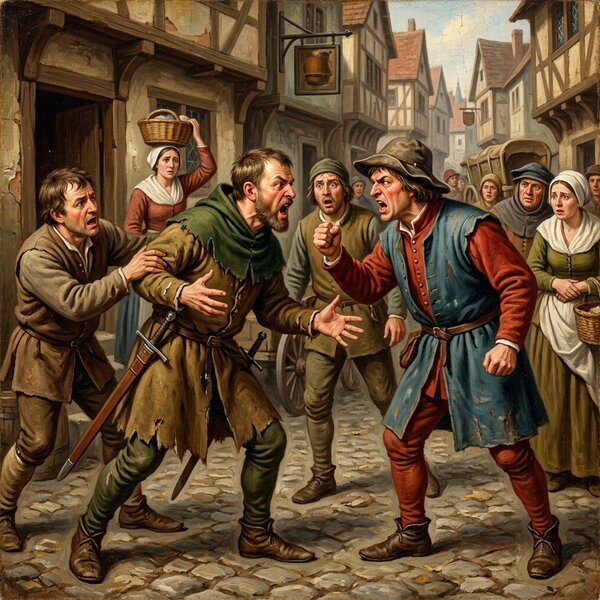
The medieval understanding of law was a world apart from our own today. Between the 11th and 15th centuries, countries such as the Holy Roman Empire, England and France had no uniform code of law. Instead, a patchwork of municipal laws, feudal laws and canon law applied, which varied from town to town.
What to expect in this article
- Key takeaways at a glance
- Introduction: Law and order in the Middle Ages – more than just torture and burning at the stake
- Dress codes and bans on luxury: when velvet and fur became criminal offences
- Prohibitions on food and drink: from compulsory fasting to the early beer protection law
- Noise, dancing and quiet holidays: sacred tranquillity enshrined in law
- Sex, marriage and morals: when the bedroom became a matter for the courts
- Animals in court: trials against pigs, roosters and locusts
- Urban and everyday regulations: fire safety, hygiene and rules of daily life
- Myths vs. reality: which ‘medieval laws’ never existed
- Conclusion: What the most curious laws of the Middle Ages reveal about our own time
- Frequently asked questions about curious laws in the Middle Ages (FAQ)
 Reading time approx. 11 mins.
Key findings at a glance
- Medieval laws governed almost every aspect of life – from clothing and food to sexuality. What sounds like satire today had a serious background at the time: the consolidation of power, fear of epidemics and religious order.
- The Church and secular rulers controlled people’s lives through a dense network of rules and regulations – covering class boundaries, fasting rules and morality.
- Many laws served primarily to maintain social distinctions and existing power structures.
- Many supposedly ‘crazy’ rules also had entirely practical reasons, such as fire safety or hygiene.
- Not everything that is today referred to as ‘medieval law’ is actually substantiated – this article distinguishes well-documented cases from later myths.
Introduction: Law and order in the Middle Ages – more than just torture and fire
The medieval understanding of law was a world apart from our own today. Between the 11th and 15th centuries, there was no uniform code of law in countries such as the Holy Roman Empire, England and France. Instead, a patchwork of municipal laws, feudal laws and ecclesiastical law applied, which varied from town to town.
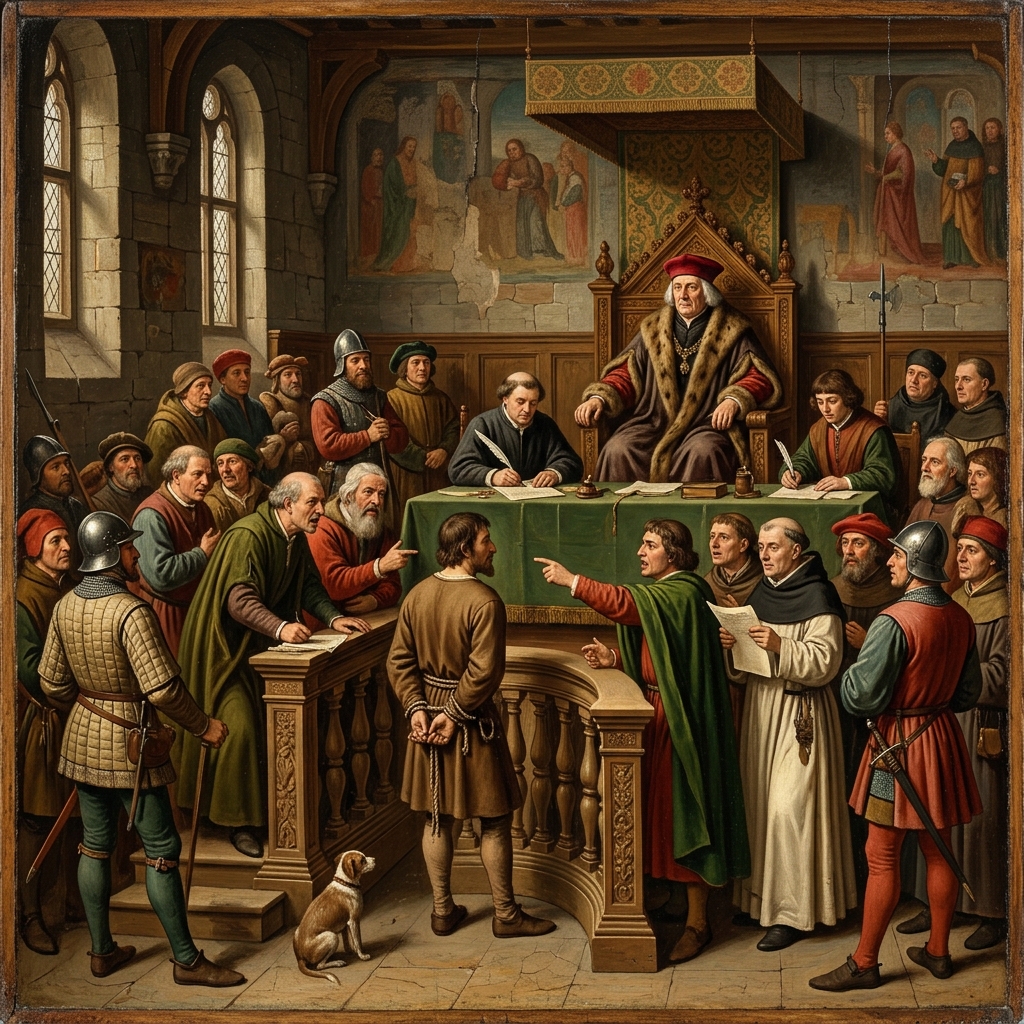
The Church played a central role in this: at the Fourth Lateran Council of 1215, far-reaching regulations were adopted, ranging from Sunday rest to marriage. A king or queen could enforce entirely different rules within their own residence than the council of a self-assured trading city.
Why do some of these laws seem absurd to us? Because we face different dangers, hold different moral values and can scarcely comprehend the strict class hierarchy of that era. The following examples form part of a fascinating legal history – some are well documented, whilst others belong more to the realm of later legends.
Dress codes and bans on luxury: when velvet and fur became criminal offences

Dress laws, known as sumptuary laws, specified exactly which fabrics and colours certain people were permitted to wear. These regulations determined who was even allowed to afford and wear certain items – regardless of their own financial means.
A specific example: the Nuremberg dress code of 1568 prohibited citizens of the lower classes from wearing velvet, sable or ermine fur, or gold embroidery. Breaches of such luxury regulations could result in hefty fines. Even the number of fur trimmings, the length of trains and the number of buttons were regulated.
In Florence, a whole series of laws was enacted as early as between 1322 and 1325, primarily regulating women’s elaborate clothing: Silk fabrics and scarlet cloth were prohibited outside one’s own home, as was clothing featuring elaborately woven or appliquéd animal, floral or tree motifs. To ensure that the regulations were widely known, municipal officials were required to read them out in public at least once a month, and priests were obliged to recite them in their churches and report any breaches to the authorities. The reason for all this was clear: the class-based society was to remain visible, and excessive waste and debt caused by a penchant for ostentation were to be prevented. Women of the middle classes were simply not allowed to dress like the nobility.
Incidentally, anyone who smiles today at strict corporate dress codes should bear in mind that the idea behind them – making social order visible through clothing – is centuries old.
Prohibitions on food and drink: from compulsory fasting to the early beer protection law
In the Middle Ages, it was not only what was eaten that mattered, but also when and by whom. Ecclesiastical fasting rules prescribed abstinence from meat on well over 100 days a year – before Easter, during Advent and every Friday.
Particularly curious: in some regions, beavers and marsh turtles were classified as ‘fish’ during Lent because they lived in water. Thus, despite being meat by nature, they were permitted on the table. Some regulations even governed the permitted possession of certain quantities of foodstuffs to prevent hoarding and profiteering.
Traders were only allowed to sell certain foods at precisely designated locations – anyone who breached this rule risked a fine. Bakers had to comply with weight and quality regulations; bread that was too light or beer that had been adulterated could result in being put in the pillory. The opening hours of taverns were regulated to prevent night-time disturbances, and municipal statutes prohibited excessive drinking binges.
Early regulations on beer production also existed: in 1303, fearing a famine, Nuremberg decreed that only barley might be used for brewing, so that other cereals could be reserved for bread-baking. In Munich, the supervision of the brewing trade was reorganised in 1363, before the city, under Duke Albrecht IV in 1447, for the first time legally restricted the ingredients for beer to barley, hops and water. These regulations are now regarded as important precursors to the Bavarian Purity Law of 1516.

Noise, dancing and quiet holidays: sacred tranquillity as law
Anyone who believes that a ban on dance events on public holidays is a modern invention is mistaken. As early as the Fourth Lateran Council of 1215, work, markets and noisy celebrations on Sundays were severely restricted. In many places, municipal ordinances made market trading and craft work on Sundays a punishable offence.
Secular and ecclesiastical authorities also prohibited ‘indecent’ dances, raucous carnival processions and performances deemed blasphemous. In England, certain forms of ‘mummery’ – masked processions and plays held near churches – were banned. Anyone who broke these rules faced fines or public humiliation.
The modern parallel is obvious: public screenings of *Life of Brian* remain restricted on Good Friday in Germany – whilst watching the film privately at home does not break any law, screening it publicly risks running afoul of the federal states’ public holiday laws. Consequently, over 700 films feature on a list for the “quiet holidays”. In many places, dance events are prohibited on Good Friday: North Rhine-Westphalia has the longest ban nationwide, lasting around 84 hours from Maundy Thursday to Holy Saturday, in Bavaria, the ban goes even further and includes all live music in pubs and restaurants – with fines of up to 10,000 euros, the highest penalty of any federal state.
The medieval notion that noise and festive culture disrupt religious order lives on in these regulations to this day. Whether it is a 13th-century synod or a modern public holidays act – the underlying principle has remained remarkably similar.
Sex, marriage and morals: when the bedroom became a legal matter
Hardly any area of life was as heavily regulated as marriage. Canon law prohibited marriages within a wide range of degrees of kinship – prior to the Fourth Lateran Council, in some cases up to the seventh degree; thereafter, the limit was lowered to the fourth degree. Without the bishop’s permission, such a ‘marriage between close relatives’ was invalid. This control primarily served to safeguard the order of succession and the legitimacy of children.
Municipal statutes provided for fines and public humiliation – such as the pillory or penitential processions – for adultery, cohabitation or night-time visits to strangers’ homes. In many Hanseatic cities, public moral transgressions were regarded as serious offences that could be brought before the municipal courts.
Particularly curious: the Church also regulated ‘marital duties’ down to the last detail – on days of fasting and major feast days, marital intercourse was officially prohibited. Anyone who contravened this was, from the Church’s perspective, committing a sin that required appropriate penance.
The notorious ‘jus primae noctis’ – the feudal lord’s alleged right to a serf’s first wedding night – cannot, however, be historically substantiated. It is a myth that only became popular in modern times. In fact, upon marriage, serfs often paid a tangible levy known as ‘Merchet’ to their lord – a financial, not a sexual, obligation, but likewise an expression of the close control exercised over the married lives of serfs.
Animals on trial: cases against pigs, roosters and locusts
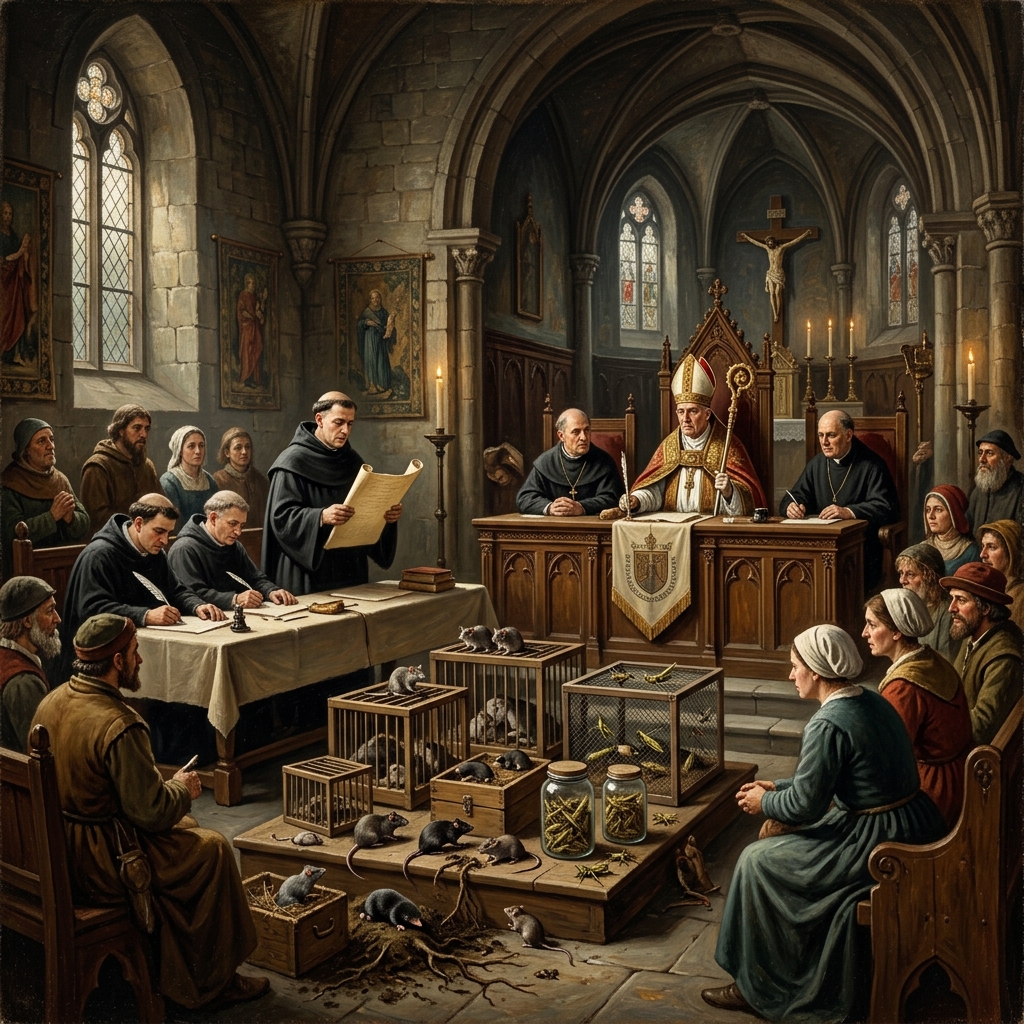
In 1386, in Falaise, Normandy, a sow was put on trial, convicted and publicly hanged after she had so severely injured the face of a three-month-old infant that the child died. The executioner in charge even received a pair of new gloves as part of his payment for the execution – so that, as it was said, he might leave the scene of the crime with ‘clean hands’. The scene was later even depicted as a fresco on a church wall in Falaise.
Even earlier, in 1266, a pig was burnt alive in Fontenay-aux-Roises near Paris for killing a child – this case is considered the earliest documented execution of an animal. In addition, there were ‘class actions’ against pests: rats, moles and locusts were formally ‘charged’ before ecclesiastical courts and threatened with excommunication or anathema if they did not leave the fields.
The background to this was deeply religious: in this world view, the divinely legitimised legal order also encompassed nature itself. It was hoped that rituals and anathemas would ward off plagues and misfortune. From today’s perspective, such trials seem like absurd theatre, but they were taken very seriously by the people of that time.
Urban and everyday regulations: fire safety, hygiene and everyday rules
Many medieval laws had entirely practical reasons, such as fire safety or hygiene – even if they seem bizarre from today’s perspective.
Animals and hygiene: In many towns, there were precise regulations governing the routes along which pigs were permitted to be driven through the town, and pigs or ducks roaming freely in the streets were banned in many places – not out of cruelty to animals, but for reasons of hygiene.
Fire and the night: At night, open fires or torches were often banned in densely built-up towns, as the risk of fire in these predominantly timber-built towns was enormous. Residents had to keep buckets, ladders or fire hooks to hand, otherwise they faced a fine. Many towns also introduced curfews to prevent night-time theft and brawls.
Market regulations: Precise regulations governing the length of loaves of bread, beer measures and prices, backed by the threat of penalties, ensured sufficient supplies of goods. Anyone who entered another’s property without permission also risked consequences.
And today? In Bad Sooden-Allendorf, according to the Old Town Regulations, only beige, pastel or sand-coloured parasols are permitted, so as not to detract from the historic half-timbered townscape – breaches can be punished with fines of up to 15,000 euros. Driving on the motorway with an empty fuel tank is prohibited and, according to the schedule of fines, can cost between 30 and 70 euros. Blind people with the appropriate parking permit are allowed to park in residents’ parking spaces for up to three hours. And beekeepers chasing their swarm of bees are even permitted, under Section 962 of the German Civil Code (BGB), to enter other people’s property – a special right that remains enshrined in the German Civil Code to this day.

Myths vs. reality: Which ‘medieval laws’ never existed
Many so-called medieval laws originate from modern joke books, tourist guides or films – good entertainment, but not historical sources.
Typical false claims: ‘It was illegal to take a bath’ – false; bathing was quite common in the Middle Ages, and there were public bathhouses in many towns. ‘Women were not allowed to make cheese’ – a grossly exaggerated claim with no reliable source. The ‘jus primae noctis’ as a widespread law that was actually enforced is also unsubstantiated.
How can you recognise genuine medieval laws? If specific municipal laws – such as Magdeburg Law or Lübeck Law – specific dates or verifiable archival sources are cited, the credibility increases considerably. Anyone who cannot find a reputable source for so-called ‘crazy laws’ should treat them more as entertaining anecdotes – not as established historical facts.
Conclusion: What the strangest laws of the Middle Ages reveal about our own time
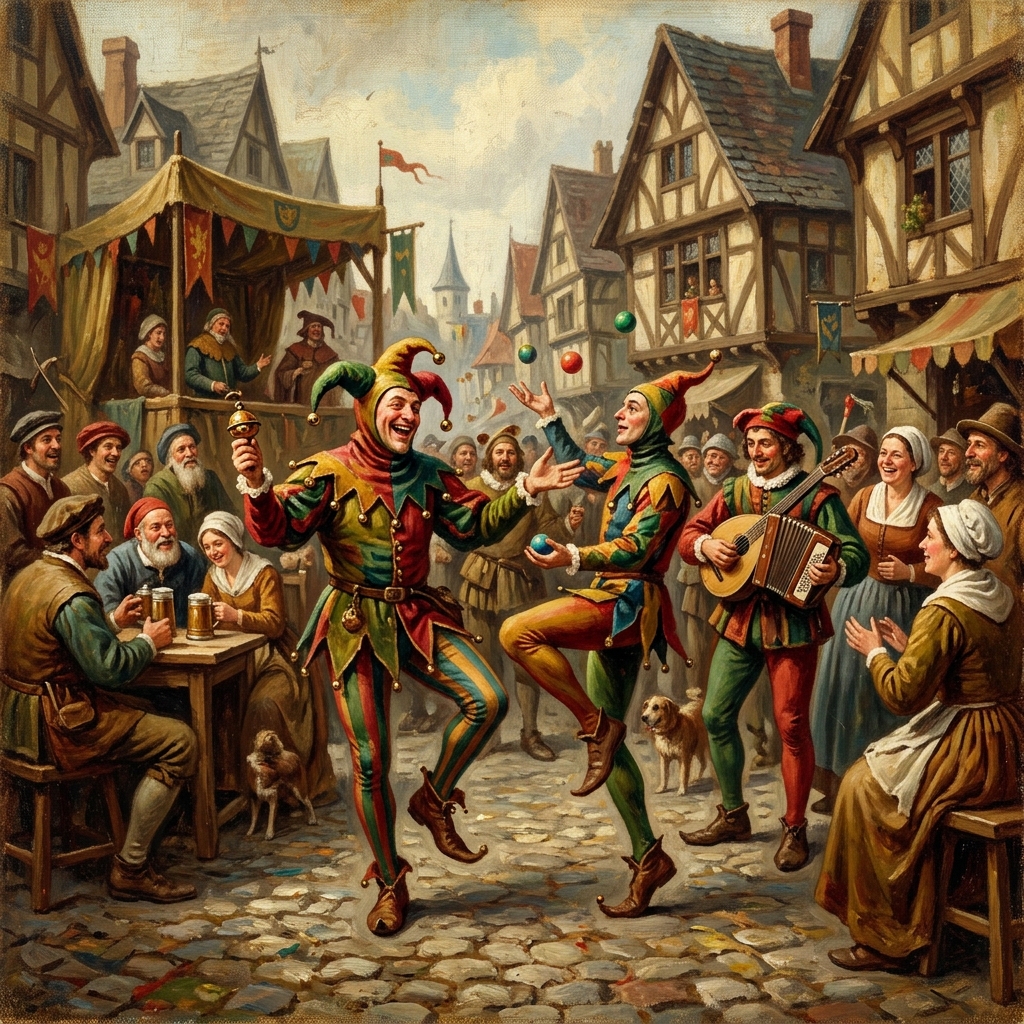
Medieval laws reflect the real fears, power dynamics and everyday problems of their time. Anyone who smiles at them should bear in mind that we, too, live by rules which will probably seem just as curious in 500 years’ time – from detailed traffic regulations to modern drone regulations.
In the past: dress codes, fasting regulations, trials of animals. Today: streaming regulations, environmental protection requirements, data protection regulations. Different technology, but a surprisingly similar need for control and order.
Perhaps future generations will laugh at our fines for illegal parking just as we chuckle today at court cases against pigs. The death penalty for a pig may seem absurd to us – but our laws today, too, will one day be stories that make people shake their heads.
Frequently asked questions about curious laws in the Middle Ages (FAQ)
Was there really a ban in the Middle Ages on mocking or laughing at the Church?
There was no general ‘ban on laughter’. However, blasphemy – open mockery of the Church and the sacraments – was severely punished: with fines, the pillory, and in extreme cases even the death penalty. A satire such as *Life of Brian* would have been regarded as blasphemy in most regions. Court jesters and street performers enjoyed certain freedoms during Shrovetide or at court, but they had no real legal protection.
Could anyone really have been arrested or tortured anywhere in the Middle Ages?
No. Torture existed as a means of obtaining evidence, but was subject to formal requirements – such as so-called ‘half-evidence’ or the necessity of a confession as stipulated in the Inquisition process. Social standing, gender and legal status – clergy, nobles, freemen or serfs – had a significant influence on an individual’s personal risk. Many disputes were instead resolved through fines, declarations of honour or arbitration.
Were these curious laws the same throughout the Middle Ages?
By no means. There were enormous legal developments between the 11th and 15th centuries. In the 13th and 14th centuries, there was a sharp increase in municipal statutes, and following the major waves of the Black Death from the mid-14th century onwards, moral rules also became stricter in many places. ‘The Middle Ages’ is not a uniform era, but a long period characterised by many different legal developments.
Are there still laws today that originate directly from the Middle Ages?
Hardly any legal text remains in force word for word, but many fundamental principles live on: market regulations, Sunday rest, and fundamental aspects of the concept of marriage. Some local traditions, such as certain market rights, can be traced back to medieval privileges, but have since been reformulated in a modern context.
How reliable are reports of ‘crazy laws’ – can they be trusted?
It is best to look for specific references to sources: if particular municipal laws, dates or verifiable archival sources are cited, the law is more likely to be based on solid grounds. Popular lists on the internet, on the other hand, often mix up medieval, early modern and simply made-up laws. If you’re seriously interested, it’s worth taking a look at reputable introductions to legal history.


Letters from the trading house
New arrivals, market dates and offers, straight from Rinchnach. Unsubscribe any time with one click.
Subscribe to the newsletter