In the Middle Ages, there were no posters, no newspapers and no internet – yet traders developed ingenious methods to attract customers, ranging from market cries and eye-catching signs to staged spectacles.

What you can expect from this article
- Key takeaways at a glance
- Introduction: Advertising in the Middle Ages – without posters or online adverts
- Why the town became an advertising stage: the rise of markets in the High and Late Middle Ages
- The market as a stage: calls, smells and spectacles
- Signs, house marks and colours: the visual branding of a medieval town
- Quality, reputation and guild symbols: trust capital as the most important form of advertising
- Language, humour and pricing strategies: Persuasion through direct conversation
- The Church, Festivals and Processions: Religious Events as a Promotional Platform for Merchants
- Long-distance trade, seals and sample books: how merchants advertised without a shop
- Prohibited advertising? Price regulations, dress codes and morality
- Everyday life in the town: How customers found their way to ‘their’ merchant
- From Medieval Advertising to Modern Marketing: What We Can Still Learn Today
- Frequently asked questions about advertising and trade in the Middle Ages (FAQ)
 Reading time approx. 13 mins.
Key findings at a glance
- In the Middle Ages, there were no posters, newspapers or the internet – yet traders developed ingenious methods to attract customers, ranging from market cries and eye-catching signs to staged spectacles.
- Signboards and images replaced written company names, as a large proportion of the population could not read.
- The town and the market served as a stage: architecture, processions and market rights provided the framework for attracting attention and fostering competition.
- A good reputation was the most effective form of advertising in the Middle Ages – guild marks and quality seals bolstered buyers’ trust over decades.
- This article draws on sources such as town charters and guild regulations, as well as examples from real cities such as Lübeck, Nuremberg and Florence.
Introduction: Advertising in the Middle Ages – without posters or online adverts

Imagine a narrow alleyway in the 13th century: traders are calling out in a jumble of voices, the scent of freshly baked bread mingles with the smell of leather and fish. How did traders in this world draw attention to themselves – without a printing press, without newspapers, without the internet?
The term ‘advertising’ in the modern marketing sense only emerged in the modern era. Yet medieval merchants certainly did use deliberate strategies to attract customers. The High and Late Middle Ages, roughly from 1050 to 1500, marked the heyday of urban trade in Central Europe, Northern Italy and Flanders. This era brought about a tremendous transformation: from the rural barter economy of the Early Middle Ages, in which monasteries were important centres of education and scholarship, to the dense, noisy, colourful towns of the 12th to 15th centuries. The invention of the printing press around 1450 revolutionised the dissemination of knowledge towards the end of this period, but until then, market cries, colours and smells were the only ‘advertising spaces’ available to people.
Why the city became an advertising stage: the rise of markets in the High and Late Middle Ages
Medieval towns began to emerge in greater numbers from the 10th century onwards, often in economically strategic locations such as river crossings, bridges or castle settlements. Customs duties and trade opportunities encouraged their establishment. In the High Middle Ages, the population grew thanks to advances in agriculture, and the rise of urban centres such as Cologne, Regensburg, Lübeck and Nuremberg accelerated. By today’s standards, many of these towns were tiny – numerous smaller market towns barely exceeded a few thousand inhabitants, and some had as few as a few hundred. Yet even these small settlements became hubs for trade and craftsmanship.
Rulers – from the Holy Roman Emperor to the local bishop or lord of the town – granted towns market rights and thus the privilege of holding weekly or annual markets. Regular fairs, such as the Frankfurt Autumn Fair – documented since the 12th century – or the later Leipzig Fairs, attracted traders from far-flung regions and intensified competition. Long-distance trade gained considerable importance during the High Middle Ages, and networks such as the Hanseatic League comprised more than 200 towns at their peak in the 14th and 15th centuries. These Hanseatic towns promoted themselves indirectly: through their reputation, security and reliable trade routes. The more competition there was within a confined space, the more important eye-catching displays and personal networks became as promotional tools.
The market as a stage: cries, smells and spectacle
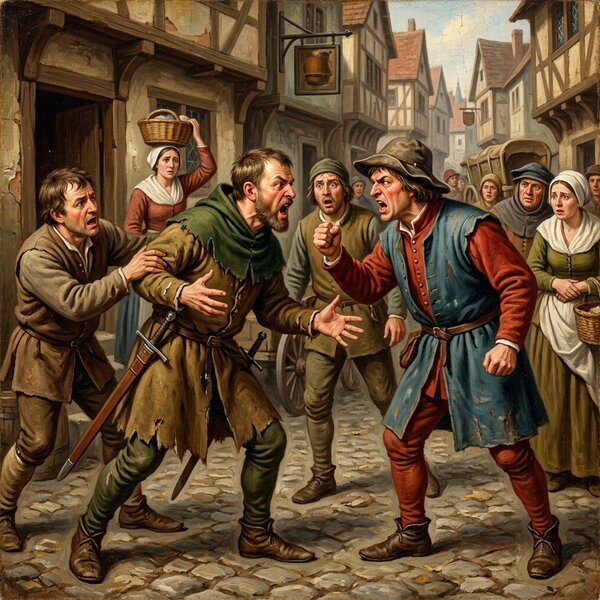
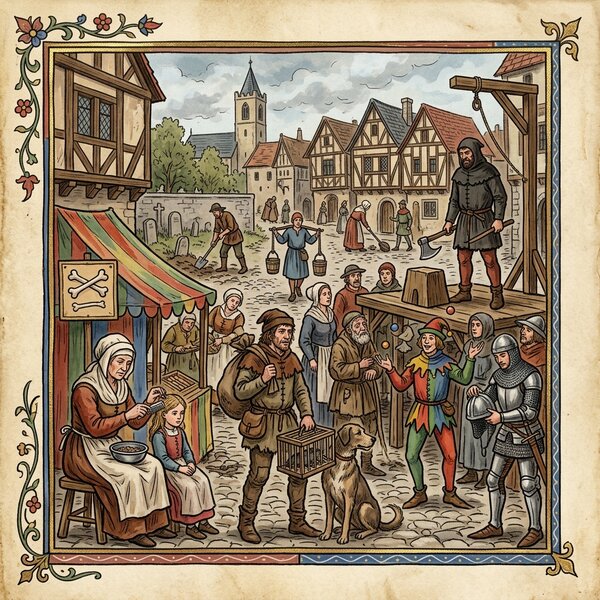
A market day in the 14th century was an assault on all the senses. Dense crowds, market criers shouting loudly, the noise of animals, the clink of metal goods – and above it all, a mosaic of smells: spices, fish, leather, freshly baked goods.
Market criers formed the acoustic heart of the market. They shouted out their wares and extolled their goods – using set phrases, exaggerations, rhymes and, at times, crude humour. Such loud, often ritualised exclamations were an integral part of everyday market life in many European trading towns and made the market a place where fun and business were closely intertwined.
Smells as a lure: bakeries and food stalls deliberately displayed freshly baked goods and roasted meat in plain view. Spice merchants let customers sniff aromatic samples. Traders displayed their finest products prominently in front of shops and market stalls – the design of the stall had a significant influence on how well the goods were perceived.
Spectacular advertising: At large annual fairs, such as those in Champagne or Flanders, jugglers, musicians, buffoons and trained animals mingled amongst the merchants. This entertainment attracted crowds, who were then more inclined to make purchases. Small show booths, games of skill and fortune-tellers served as attractions – an early form of event marketing which, in some respects, is reminiscent of today’s medieval markets.
Signs, shop signs and colours: the visual branding of a medieval town

As a large proportion of the town’s inhabitants in the High and Late Middle Ages could not read, or could read only to a limited extent, pictorial signs, symbols and colours dominated as identifying features. Merchants relied on distinctive signs and symbols for recognition – thereby creating a visual system that functioned with astonishing effectiveness.
Inns bore names such as ‘Zum Goldenen Löwen’, ‘Zur Krone’ or ‘Zum Schwarzen Adler’, depicted as pictorial signs above the door. Bakers displayed a pretzel, blacksmiths a horseshoe, and cobblers a boot. In Nuremberg, for example, numerous houses were identified by such house signs. It was not until 1796 that the city council, under pressure from the occupying power of the time, introduced separate house numbers for the Sebald and Lorenz sides of the city, primarily to facilitate the quartering of soldiers – evidence of just how long the pictorial system had functioned beforehand.
Guild symbols complemented this system: plaques and coats of arms often marked entire neighbourhoods belonging to specific guilds – such as furriers, tanners or clothmakers – and created a sort of ‘trade district’. Customers thus knew immediately where to find particular goods.
Colours also carried social connotations: red and gold signalled wealth, whilst blue stood for particularly precious dyes. Shops displaying coloured cloths, banners or painted awnings thus showcased their high-quality range – a visual promise that required no writing at all.

Quality, reputation and guild symbols: trust capital as the most important form of advertising
Medieval society was strictly organised into estates: At the top stood the king; knights emerged from around the 9th century in connection with mounted warfare and reached their heyday in the 12th century; peasants formed the largest but socially weakest group; and feudal ties held the system together. Social mobility between the estates was virtually impossible. In trade, however, a craftsman or merchant could significantly improve their economic standing through quality and reputation.
Personal reputation was the key marketing tool. The guilds played a central role in this: they monitored minimum quality standards, checked weights and measures, and protected customers from fraud. Guild and quality marks thus bolstered buyers’ confidence over the long term. Guild marks – marks of approval and origin awarded by individual guilds – were regarded as a guarantee of reliable craftsmanship and were protected accordingly by the guilds.
Personal persuasiveness was important for merchants’ sales success, but it was not enough on its own. Apprenticeship within a guild – from initial training through to master status – ensured quality across generations. Word of mouth further spread the reputation: pilgrims, travelling merchants and students at the first universities, which emerged from the late 11th century onwards and particularly in the 12th century, told others in other places about good or bad merchants – a medieval review site made up of flesh and blood.
Language, humour and pricing strategies: persuasion through direct conversation
Medieval advertising took place largely through direct sales conversations. The merchant was a salesman, an entertainer and a trusted advisor all at once. Linguistic tricks were central to this:
- Exaggerations: ‘The finest cloth from Flanders!’, ‘The most exquisite silk from Venice!’ – referring to prestigious places of origin was common practice.
- Religious oaths: “By the Holy Virgin!” affirmed honesty – a tactic that carried real weight in a deeply religious society.
- Humour and theatrics: Sellers would joke about the competition, tear sample pieces to demonstrate durability, or offer small samples of exotic spices.
Pricing strategies were also sophisticated. Volume discounts for regular customers, discounts in kind – such as an extra item when purchasing a larger quantity – and the deliberate placement of cheaper goods prominently at the front, whilst more expensive items were discreetly positioned further back, were all part of the repertoire. The growing use of money in the late Middle Ages also made it easier for shoppers to compare prices, thereby further intensifying competition.
Merchants also adapted their language: they tended to use the local dialect when speaking to farmers from the surrounding countryside, and simpler, more understandable phrases when dealing with merchants from further afield – an early expression of customer focus, tailoring their tone and approach to the respective target group.
Church, festivals and processions: religious events as a promotional platform for traders

In the Middle Ages, numerous markets were linked to church festivals: patron saint’s days, church consecration days, and Easter and Whitsun markets. These events drew pilgrims and visitors into the town and provided merchants with a concentrated audience.
Merchants made strategic use of these fixed dates: candles, pilgrim badges and rosaries at saints’ days, jewellery and cloth during the wedding season, and confectionery at Shrove Tuesday. The trade in pilgrim badges was particularly flourishing at major pilgrimage sites such as Santiago de Compostela, where the scallop shell served as the pilgrims’ distinguishing mark, or in Cologne, where the relics of the Three Kings, kept in the cathedral since 1164, gave rise to distinctive pilgrim badges depicting the Adoration of the Magi. Pilgrims took these small badges home with them as visible souvenirs – and thereby unconsciously promoted the place of pilgrimage in their own homeland.
Processions and sermons also drew large crowds. Stalls along procession routes and in church squares thus enjoyed a real locational advantage with high visibility. Monasteries also promoted themselves indirectly: monastic products such as beer from southern German monastery breweries, wine or the ornate manuscripts produced in the scriptoria benefited from the reputation of the respective institution, much like an early form of brand equity. In many parishes, women also took on the role of healers, selling herbal mixtures and home remedies at church fairs. Culture and trade were closely intertwined at such festivals.
Long-distance trade, seals and sample books: how merchants without shops promoted their wares
Many long-distance traders of the late Middle Ages – Hanseatic merchants from Lübeck, Italian banking families from Florence – did not maintain permanent shops in every town, but operated through trading posts, intermediaries and trade fairs. How did they build trust and a reputation without a permanent physical presence on the ground?
Their most important tools were seals and marks: distinctive company logos on letters, deeds and contractual documents that signalled trustworthiness. Neatly kept account books and long-term credit relationships also served as a kind of documented reputation.
Sample books and sample bales functioned in much the same way as modern product catalogues: cloth merchants from Flanders, for example from Ypres or Ghent, presented high-quality woollen cloths at major trade fairs, such as those in Frankfurt or Geneva. This allowed merchants from other regions to assess the quality before ordering larger quantities. Sending such samples over long distances was a deliberate investment in customer acquisition.
Major trading houses such as the Augsburg-based Fugger and Welser families, who rose to become among the most prominent banking and trading families in Europe during the 15th and 16th centuries, used distinctive coats of arms and symbols to mark their goods and commercial correspondence. Letters of recommendation from princes or bishops served as an early seal of approval, attesting to a merchant’s reliability in the eyes of other business partners. Such letters could have a decisive influence on a merchant’s fortunes in a foreign city.
Prohibited advertising? Price regulations, dress codes and morality
Medieval advertising was subject to considerable legal and moral restrictions. Town charters and guild regulations generally laid down binding rules on prices, measurements and quality standards, thereby also setting clear limits on merchants’ self-promotion.
In Nuremberg, for example, municipal regulations in the 14th and 15th centuries prohibited the use of false weights, overcharging for wine and the sale of spoiled meat. Public proclamations specifically intended to defame competitors were punished in some towns with fines, public shaming or temporary bans from the market.
Dress codes and bans on luxury goods – repeatedly re-enacted in Florence, for example, from 1281 onwards – also indirectly restricted a form of ‘status display’: depending on their social class, citizens were permitted to wear only certain clothing and jewellery in order to maintain visible distinctions between social classes. These regulations particularly often concerned women’s clothing; however, in some places, wealthy women could buy their way out of the restrictions by paying a kind of special tax. Similar regulations also existed in many German imperial cities.
Church sermons on morality also took aim at what was perceived as ‘excess’ in trade. Tensions between economic interests and Christian ethics permeated the markets throughout the Middle Ages. The outcome was usually a compromise: promotion was permitted – but within narrow, clearly defined limits.

Daily life in the town: how customers found their way to ‘their’ shopkeeper
Imagine a woman living in a town in southern Germany around 1450: in the morning she goes to the baker’s in Bäckergasse, then to the grocer’s at the market, and in the afternoon to the cobbler’s in Schmiedgasse. Fixed street names and neighbourhood structures made it easier to find your way around – Bäckergasse, Metzgergasse or Krämermarkt acted as a kind of location advertisement simply by virtue of their existence.
Relationships with regular customers often spanned generations: families knew ‘their’ tradespeople, ran up a tab or paid later – trust and goodwill were key factors in building these bonds. The purchase of everyday goods was not an anonymous transaction, but a social ritual. In many towns, women were economically active and often managed the household shopping – a role that required practical knowledge of the market.
Visitors from outside – farmers from the surrounding countryside, pilgrims, itinerant tradespeople – would initially seek out large, eye-catching stalls, well-known inns or the recommendations of other townspeople. In town chronicles and travel accounts from the late Middle Ages, one repeatedly finds praise or criticism of particular markets and taverns – an early form of ‘reviews’ that reveal a great deal about everyday life.
From medieval advertising to modern marketing: what we can still learn today
The principles of medieval advertising are reflected in modern marketing in a strikingly similar form:
| Medieval | Modern equivalent |
|---|---|
| Market cries | Social media posts, video adverts |
| Shop signs | Logos and corporate identity |
| Fairs | Trade fairs, pop-up events |
| Letters of recommendation | Online reviews |
| Master craftsman’s mark | Seals of quality, designations of origin |
Even today, brands deliberately capitalise on history and regional origin – names such as ‘Nuremberg gingerbread’ or ‘Lübeck marzipan’ draw on a concept that was already effective in the Middle Ages. Your favourite local shop just round the corner still benefits today from mechanisms that medieval merchants were already using successfully several centuries ago.
A sober look at medieval economic history, as offered by modern medieval studies, helps to overcome clichés about this supposedly ‘dark’ age. Over the centuries – from antiquity through the Middle Ages to the Renaissance and the Reformation – a consistent pattern emerges: good marketing has always been a combination of trust, presentation and having the right product at the right time.
Anyone visiting medieval markets today gets a vivid, if romanticised, impression of how presentation and the struggle for attention shaped everyday life at a medieval market.
Frequently asked questions about advertising and trade in the Middle Ages (FAQ)
Were there such things as branded products in the Middle Ages?
There were no modern brand names in the sense we understand them today, but there were certainly recognisable ‘brands’. Certain workshops, towns or guilds were synonymous with a particular standard of quality – such as Nuremberg metalware, Flemish cloth or Lübeck marzipan in the late Middle Ages. Master’s marks, stamped into metalware or the selvedges of cloth, identified the manufacturer. City coats of arms on bales of goods or distinctive barrel markings served as early identifying marks. These marks were often protected by the guilds and helped buyers to assess quality even over long distances – a principle that, at its core, is already very close to modern branding.
How were new products publicised when there were no newspapers?
News of new products spread mainly through market criers, demonstrations at stalls and word of mouth. When a trader introduced exotic goods such as pepper, cinnamon or special dyes, he would explain their origin, uses and benefits in detail – often with small samples or trial items. Travelling merchants carried information about new products from town to town, thus acting as living advertising media. It was not until the end of the Middle Ages that the invention of the printing press enabled a significantly wider and faster dissemination of information about new products.
What role did the Church play in regulating trade?
The Church preached against usury, fraud and excessive greed in trade, and for a long time also raised theological objections to the charging of interest. Many markets were tied to church festivals, and clergy exerted influence over market times, Sunday rest and the moral limits of advertising and entertainment in the vicinity of churches. This ecclesiastical control created an ethical framework intended to steer economic activity along acceptable lines – not always with resounding success, but with a noticeable impact on the daily lives of traders.
Were customers legally protected against fraud in the Middle Ages?
Yes – town charters and guild regulations contained detailed provisions on measures, weights and quality. Municipal officials such as weighmasters and market inspectors checked scales, barrels and bread sizes at irregular intervals. Violations were punished with fines, confiscation of goods, public shaming or temporary bans from the market – an early form of consumer protection which, at the same time, strengthened confidence in the market as an institution as a whole.
How did advertising in rural areas differ from that in towns and cities?
In rural areas, there were significantly fewer permanent shops. Peddlers, travelling traders and seasonal fairs played a greater role there, and advertising relied primarily on word of mouth and a loyal customer base. For larger purchases such as cloth, metal goods or salt, villagers would make a special trip to nearby towns or larger market towns, where urban forms of advertising were concentrated: signs, market criers, jugglers and colourful stalls. Throughout the Middle Ages, the town remained the true centre of professional customer engagement.


Letters from the trading house
New arrivals, market dates and offers, straight from Rinchnach. Unsubscribe any time with one click.
Subscribe to the newsletter