Gloomy vaults, red-hot irons, screaming victims and fanatical monks in dark robes – this is how films and TV series portray the Inquisition. Hardly any other chapter in the history of the Church has become such a horror cliché. But how much of it is history and how much is Hollywood?

Here’s what you can expect in this article
- Key points at a glance
- What exactly was ‘the Inquisition’?
- How the Inquisition came about
- From the ‘Judgement of God’ to the ‘Inquisitio’: progress or a new threat?
- How the medieval Inquisition operated
- Torture: How often and how brutal?
- How many people died as a result of the Inquisition?
- The Spanish Inquisition: A Special Case with Its Own Particular Severity
- The Roman Inquisition: Control of doctrine and books
- Bernard Gui: the inquisitor from *The Name of the Rose*
- ‘The Name of the Rose’: How close are the novel and the film to reality?
- Fact-checking typical film clichés
- The ‘Black Legend’: How propaganda shaped the image
- Was the Inquisition worse than secular courts?
- Criticism and change within the Church
- Conclusion: Brutal – but different from the film
- FAQ on the Inquisition
 Reading time approx. 14 mins.
Key points at a glance
In this fact-check, we separate verifiable facts from myths, propaganda and artistic exaggeration. We look at how the Inquisition came about, how often torture and executions actually took place, what lies behind the ‘Black Legend’ and how close *The Name of the Rose* is to reality. First things first: this article does not seek to sugar-coat anything. It simply aims to take a close look.
- The Inquisition did use torture and sent people to their deaths. That is undisputed. However, the scale and day-to-day reality were usually quite different from what is portrayed in the film.
- There was no single ‘Inquisition’. There were various tribunals over the centuries: the medieval, the Spanish and the Roman Inquisitions.
- The vast majority of trials did not end in death, but in penance, pilgrimages, wearing hair shirts or imprisonment.
- As regards the Spanish Inquisition, an analysis of around 44,700 trial records from the years 1540 to 1700 shows that approximately 1.8 per cent of the accused were actually executed. In the early days, the proportion was significantly higher.
- The grim portrayal in films can also be traced back to the so-called ‘Black Legend’ – anti-Spanish and anti-Catholic propaganda that began as early as the 16th century.
What exactly was ‘the Inquisition’?
The word comes from the Latin ‘inquisitio’, meaning ‘investigation’. It refers to ecclesiastical proceedings designed to detect and punish heresy – that is, deviation from the Church’s faith. Crucially, there was not just one Inquisition, but several, which differed greatly in terms of time, place and methods.
| Period | Time period | Focus |
|---|---|---|
| Medieval Inquisition | from 1231 (papal inquisitors) | Southern France, Northern Italy |
| Spanish Inquisition | 1478–1834 | Spain and its territories |
| Portuguese Inquisition | 1536–1821 | Portugal and its territories |
| Roman Inquisition | from 1542 | Italy, religious and book censorship |
In the medieval worldview, heresy was not simply a ‘different opinion’. The Church, society and the political order were regarded as a single entity – anyone who deviated from the faith appeared to threaten the entire structure. For this reason, the Church and secular rulers worked closely together in the persecution of heretics.
An important detail: the Inquisition did not carry out death sentences itself. Canon law forbade clergy from shedding blood. Anyone deemed an incorrigible or recidivist heretic was handed over to the ‘secular arm’ – which then carried out the execution, usually at the stake. Morally, this makes little difference, but legally, that was how it was regulated.
How the Inquisition came into being
In the 12th century, criticism of wealth and abuses within the Church grew across Europe. New religious movements challenged ecclesiastical authority. Two stood out in particular:
- The Cathars, particularly in southern France, espoused a dualistic doctrine in which the material world was regarded as evil. They rejected the sacraments of the Church.
- The Waldensians, named after the Lyon merchant Peter Valdes, advocated a life of poverty and preached as laypeople – which the clergy saw as an attack on their authority.
In 1184, Pope Lucius III issued the bull ‘Ad abolendam’, obliging bishops to actively seek out heretics in their dioceses. In 1209, the Albigensian Crusade against the Cathars began; it lasted until 1229 and laid waste to the south of France. And in 1231, Pope Gregory IX appointed his own papal inquisitors for the first time – primarily Dominicans, and later Franciscans as well. Thus, the Inquisition was born as an institution.
From trial by ordeal to the ‘Inquisitio’: progress or a new danger?

In the early Middle Ages, trials by ordeal often determined guilt or innocence. In the ‘trial by water’, a suspect was bound and lowered into water: if he sank, he was deemed innocent. In the ‘trial by fire’, he had to carry a red-hot iron; if the wound healed well, he was acquitted. It was believed that God Himself passed judgement.
In the 12th and 13th centuries, doubts about such procedures grew. In 1215, the Fourth Lateran Council prohibited clergy from participating in trials by ordeal – a turning point. These were increasingly replaced by the inquisitorial process: the judge investigated ex officio, rather than waiting for a private complaint. Witnesses were questioned, and everything was recorded.
On paper, this represented progress compared with pure arbitrariness. In practice, however, the system had a dark side. The names of the witnesses for the prosecution were often withheld from the accused, anonymous accusations were possible, and enormous power was concentrated in the hands of the inquisitor. What was intended as an orderly procedure could become a trap for the innocent.
How the medieval Inquisition worked
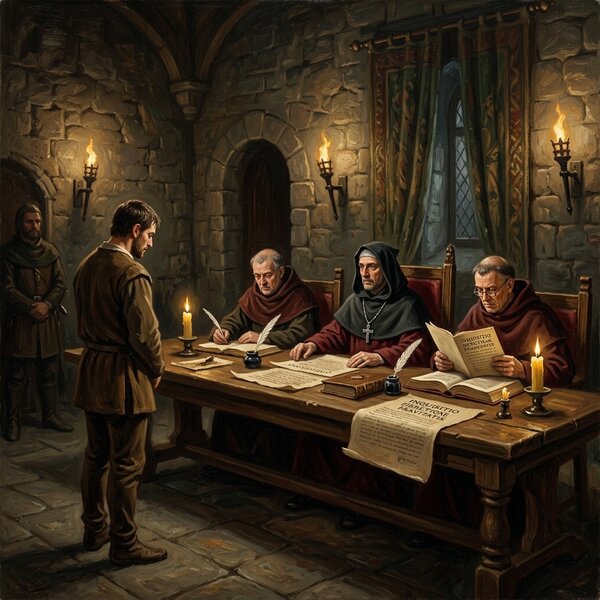
The day-to-day life of an inquisitor was more mundane than films might suggest, and consisted largely of paperwork:
- The inquisitor would arrive in a region with a small staff and publicly call on people to come forward of their own accord within a grace period. Those who did so and repented received a lighter penalty.
- Once the grace period had expired, investigations began on the basis of complaints and witness statements.
- Suspects were summoned and interrogated. Many of these records have survived to this day.
- The outcome was a judgement that could range from penances and imprisonment to handing the accused over to the secular authorities.
Most punishments were not death sentences. Typical penalties included pilgrimages, wearing yellow crosses sewn onto clothing as a sign of penance, confiscation of property or imprisonment – in the worst cases, for life. An example from Toulouse: in a major investigation in 1245–46, around 5,400 people were interrogated. 184 were required to wear yellow crosses, 23 were sentenced to life imprisonment – yet no one was sentenced to death.
The paradox is this: it is precisely because the Inquisition kept such thorough records that we know so much about it today. Secular courts, which often handed down sentences no less harsh, left far fewer traces in many places.
Torture: How often and how brutally?
In 1252, Pope Innocent IV, in the papal bull ‘Ad extirpanda’, authorised the use of torture to extract confessions – expressly not as a punishment. The bull set limits: torture was not permitted to cause bloodshed, maim or kill, and its use was restricted to a limited duration.
It is important to note that the Inquisition did not invent torture. It was widespread in the criminal law of the late Middle Ages and the early modern period, including in secular courts.
The Spanish Inquisition primarily employed three methods: the ‘garrucha’, in which the victim was hoisted up by their hands, which were bound behind their back; the ‘toca’, a form of water torture; and the ‘potro’, a kind of rack – presumably the most common method. A doctor was usually present, who first had to certify that the prisoner would survive the torture. A confession made under torture had to be confirmed later without coercion.
This sounds like a regulated process – but it was only so to a limited extent. The rules could be circumvented, for example by simply treating a new session of torture as a ‘continuation’ of the first. Pain, fear and lasting damage were very real. The frequency of torture is a matter of debate amongst researchers and varied greatly depending on the time, place and nature of the allegation. However, the notion that torture was used in every trial is incorrect.

How many people died as a result of the Inquisition?
Older Protestant and anti-Catholic accounts spoke of hundreds of thousands or even millions of victims. Modern research, based on surviving records, arrives at significantly lower figures – even though estimates vary.
| Inquisition | Research findings |
|---|---|
| Bernard Gui, Toulouse (1307–1323) | 930 judgements, including 42 executions and 307 prison sentences |
| Spanish Inquisition, total (1478–1834) | around 150,000 cases; figures of around 3,000 to 5,000 executions are frequently cited, though some researchers estimate a higher number |
| Spanish Inquisition, early phase (up to around 1530) | according to Henry Kamen, around 2,000 executions, mainly of conversos |
| Spanish Inquisition, 1540–1700 | Analysis of around 44,700 trial records: 826 executions carried out, i.e. approximately 1.8 per cent |
The figures reveal two things. Firstly: the Spanish Inquisition was significantly more deadly in its early decades than it was later on. Secondly: the scale is far below what horror stories claim. That does not make a single victim’s suffering any less severe. Every execution on the grounds of religious belief was an injustice.
The Spanish Inquisition: a special case with its own severity

The Spanish Inquisition was founded in 1478 at the instigation of the Catholic Monarchs, Ferdinand II of Aragon and Isabella I of Castile; Pope Sixtus IV gave his approval by papal bull. Its initial target was the conversos – Jews who had converted to Christianity and their descendants – who were accused of secretly clinging to the Jewish faith. Later, the Moriscos – Muslims who had been forcibly baptised – as well as Protestants and other groups also came under scrutiny.
Unlike the medieval Inquisition, the Spanish Inquisition was closely tied to the Crown. It also served to exert political control and enforce religious unity within the empire. Typical features included:
- Autodafés – public ceremonies at which sentences were pronounced, serving simultaneously as a demonstration of power
- the confiscation of the convicted persons’ assets
- a network of informants and denunciations
- extensive proceedings involving files, expert witnesses and limited opportunities for defence
The Spanish Inquisition was not finally abolished until 1834.
The Roman Inquisition: control over doctrine and books
In 1542, Pope Paul III established a central authority in Rome for matters of faith: the Roman Inquisition. The backdrop to this was the Reformation, which had divided Europe. Closely linked to it, from 1559 onwards, was the Index of Prohibited Books, which classified writings as a threat to the faith.
Two cases continue to define the image of this authority to this day:
- Giordano Bruno (1548–1600): The former Dominican friar and philosopher was convicted of heresy and burnt at the stake on 17 February 1600 in Rome’s Campo de’ Fiori.
- Galileo Galilei (1564–1642): He was condemned in 1633 as ‘strongly suspected of heresy’, was forced to recant his teachings and spent the rest of his life under house arrest. He was neither tortured nor executed.
From the 18th century onwards, the influence of the Roman Inquisition waned. In 1908, it was renamed the ‘Holy Office’, and in 1965, at the conclusion of the Second Vatican Council, it became the ‘Congregation for the Doctrine of the Faith’. Since 2022, it has been known as the “Dicastery for the Doctrine of the Faith”.
Bernard Gui: the inquisitor from *The Name of the Rose*
Bernard Gui was born in the Limousin region around 1261/62 and joined the Dominican Order. From 1307 to 1323, he served – with a brief interruption – as an inquisitor in Toulouse. He wrote a comprehensive handbook for inquisitors, the *Practica inquisitionis heretice pravitatis*, which is now one of the most important sources for research. In 1324, he became Bishop of Lodève, where he died in 1331.
His surviving judgements paint a sobering picture: 930 judgements during his tenure, including 42 executions and 307 prison sentences. The remainder were penances; many of those convicted were required to wear yellow crosses. This is no acquittal – 42 people died. But it is a far cry from a judge who sets pyres alight on an assembly-line basis.
In *The Name of the Rose*, Gui is portrayed as a fanatical, sadistic judge. In the 1986 film adaptation, he even meets a violent end: enraged peasants plunge his carriage into the abyss. This has nothing to do with the historical record. The real Gui died of natural causes whilst serving as a bishop.
*The Name of the Rose*: How close are the novel and the film to reality?
Umberto Eco published his novel in 1980; this was followed in 1986 by Jean-Jacques Annaud’s film adaptation, starring Sean Connery as William of Baskerville. For millions of people, both continue to shape the image of the medieval Inquisition to this day.
The story is set in 1327 in a Benedictine abbey in northern Italy. A series of mysterious murders coincides with a meeting between Franciscans and papal envoys, and with Bernard Gui’s arrival, fear and torture enter the monastery. In the end, the library goes up in flames.
Eco deliberately blended history and fiction. The dispute over poverty between the Franciscans and the Papacy, the tensions with the Curia and the climate of persecution of heretics all have a real-life background. The series of murders, the dramatic fire scenes and much more, on the other hand, are fictional. Eco himself described a novel as a ‘machine for generating interpretations’ – he wanted to ask questions, not write a history book.
Fact-checking typical film clichés
| Cliché | What is historically accurate | Where it is exaggerated |
|---|---|---|
| Torture in every trial | Torture was permitted and did occur | It was regulated and not common in every trial |
| Burning at the stake everywhere | Executions took place, carried out by the secular authorities | The proportion of all trials was small |
| Complete lack of legal rights | Anonymous witnesses, the inquisitor’s immense power | There were records, time limits and, in some cases, a defence |
| Sadistic monks | There were harsh and fanatical inquisitors | Many worked primarily in a bureaucratic capacity |
| The Inquisition burned most witches | Inquisition courts also prosecuted witchcraft | The major witch hunts were conducted by secular courts |
What films almost never show: lengthy interrogation transcripts, expert reports, deadlines and rather unspectacular verdicts such as pilgrimages. This reality simply does not lend itself to grand cinematic moments.
The ‘Black Legend’: How propaganda shaped the narrative
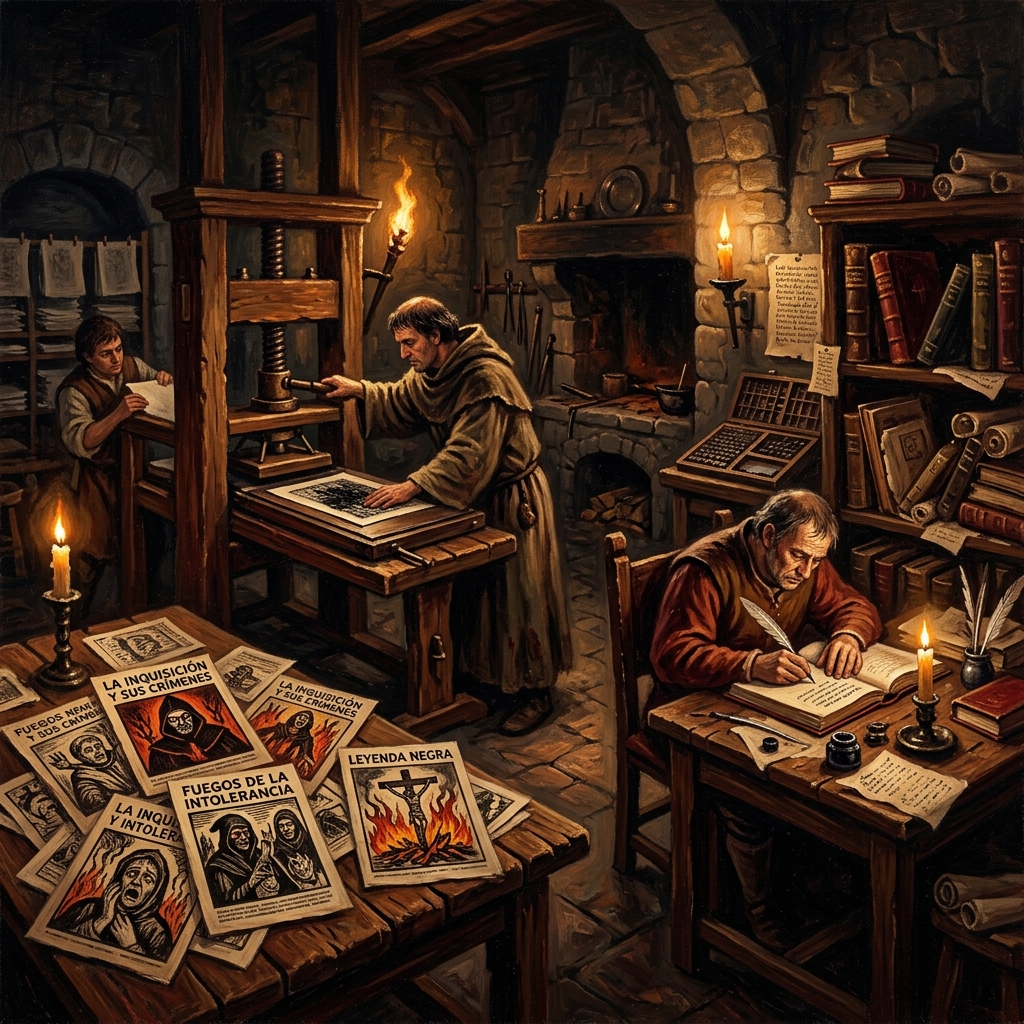
The term ‘Black Legend’ (Spanish: ‘leyenda negra’) became widely known primarily through the 1914 book by the Spanish historian Julián Juderías. It describes an anti-Spanish and often anti-Catholic portrayal of history, the roots of which stretch back to the 16th century.
At that time, Spain and its adversaries – foremost among them the rebellious Netherlands and England – were locked in a struggle for power and faith. Pamphlets, books and images portrayed Spain and its Inquisition as the embodiment of unparalleled cruelty. In the 19th century, liberal historians and horror novels turned the Inquisition into the epitome of ecclesiastical darkness. Many of these images live on today in films and TV series.
The core of the story was real: there was torture, executions and arbitrary rule. However, the figures and its alleged uniqueness were massively exaggerated. Modern historians such as Henry Kamen are attempting to correct this image without trivialising the actual crimes.
Was the Inquisition worse than secular courts?
Anyone who views the Inquisition in isolation overlooks the rest of the legal system of the time. Secular courts, too, employed torture, imposed public executions even for theft, and meted out punishments involving mutilation.
This is particularly evident in the witch hunts. The major waves of persecution, especially in the Holy Roman Empire, were predominantly instigated by secular courts, not by the Spanish or Roman Inquisition. Admittedly, the Spanish Inquisition had six people burnt at the stake as witches in 1610 following the auto-da-fé in Logroño. However, its inquisitor, Alonso de Salazar Frías, subsequently investigated the allegations thoroughly and found no evidence. In 1614, the supreme inquisitorial authority enacted stricter rules of evidence, and witch burnings in Spain thus practically ceased.
This does not detract from the fact that the Inquisition was an instrument of religious and political oppression and was partly responsible for death sentences, fear and censorship. But it was not the only such institution of its time, nor was it always the harshest.
Criticism and change within the Church
The Church was never a monolithic bloc. Even within the Church, there were voices that rejected coercion in matters of faith or called for moderation – and cases such as that of Salazar show that inquisitors themselves could become critics. With the Enlightenment, the spirit of tolerance and the realisation that different denominations could coexist, the Inquisition finally lost its foundation in the 18th and 19th centuries.
On 12 March 2000, during a service in St Peter’s Basilica, Pope John Paul II asked for forgiveness for the sins of Christians in the past, explicitly including intolerance and violence in the name of truth. As early as 1998, the Vatican had organised an international symposium on the history of the Inquisition. At the event, historians emphasised that torture and death sentences were less common than had long been assumed – without, however, downplaying the injustices committed.

Conclusion: Brutal – but not as depicted in films
The answer to the original question is clear: the Inquisition was genuinely brutal. It tortured people, sent them to their deaths and violated fundamental rights. No fact-check can excuse that.
Yet in everyday life, it was usually less spectacular than film clichés suggest. Most trials ended with penance, pilgrimages or imprisonment; torture was regulated and not ubiquitous; and death sentences were – with the exception of a few particularly cruel periods – the exception. Films such as *The Name of the Rose* raise important questions about power, truth and oppression. They are not history books.
The next time you come across a documentary, a film or a social media post about the Inquisition, ask for sources, figures and context. The people who suffered back then deserve more than just horror stories: they deserve the truth. And anyone who wants to experience history for themselves – whether through re-enactments, LARP or at a medieval fair – will soon realise just how much more fascinating the real past is.
FAQ on the Inquisition
Did the Inquisition persecute scientists such as Galileo Galilei?
Yes. The Roman Inquisition condemned Galileo Galilei in 1633 for advocating the heliocentric model of the universe. He was forced to recant and subsequently lived under house arrest in his villa near Florence. He was neither tortured nor executed. His trial nevertheless remains a symbol of the conflict between ecclesiastical doctrinal authority and free research. Many other scholars, including numerous members of religious orders, pursued astronomy and natural history without being persecuted.
Did the Inquisition burn most witches?
No. That is one of the most persistent misconceptions. The major witch hunts took place primarily in the Holy Roman Empire and were predominantly conducted by secular courts. Following the trials in Logroño from 1614 onwards, the Spanish Inquisition enforced strict rules of evidence, thereby largely bringing an end to witch burnings in Spain.
Was it even permitted to think differently in the Middle Ages?
Open heresy was regarded as an attack on the entire social order and was dangerous. At the same time, theological and philosophical questions were often debated with surprising openness at the universities. Whether a movement was tolerated or persecuted depended heavily on the time, place and balance of power. There was no total ban on free thought, but the limits of what could be said were much narrower than they are today.
Were there also lenient inquisitors?
The sources paint a mixed picture. Some inquisitors acted fanatically and harshly, whilst others were fair and restrained. Alonso de Salazar Frías, for example, opposed the witch hunts. From today’s perspective, however, the entire system remains problematic, for even a ‘lenient’ inquisitor operated within a structure that permitted coercion of conscience and torture.
Did Joseph Ratzinger revoke Hans Küng’s licence to teach?
No, that is a common misconception. Küng lost his ecclesiastical teaching licence in 1979, when the Congregation for the Doctrine of the Faith was still headed by Cardinal Franjo Šeper. Joseph Ratzinger, who later became Pope Benedict XVI, was Prefect only from 1981 to 2005. Among other things, the proceedings against the Brazilian liberation theologian Leonardo Boff took place during his tenure.
How reliable are today’s figures?
Many archives relating to the Inquisition, particularly in Spain and Italy, are well preserved, and historians have analysed tens of thousands of trial records. Nevertheless, there are gaps, particularly regarding the early days of the Spanish Inquisition. Researchers therefore work with ranges and estimates. If you come across figures for the number of victims that are extremely high or extremely low, it is always worth questioning the source.
Letters from the trading house
New arrivals, market dates and offers, straight from Rinchnach. Unsubscribe any time with one click.
Subscribe to the newsletter