









In the Roman Empire, poisoning was the invisible weapon of power. Whilst daggers and swords left traces, poison worked in secret – perfectly disguised in wine, mushroom dishes or honey, almost impossible to detect, invisible, and sometimes deadly with terrifying precision. Ancient sources conspicuously often name women as the perpetrators: professional poisoners such as Locusta, power-hungry empresses such as Agrippina the Younger, and countless nameless matrons who allegedly disposed of their husbands or rivals. But how much of this is historical reality – and how much is political propaganda that retrospectively portrayed powerful women as monsters?
Here’s what you can expect in this article
- Key points at a glance
- Poisonings in the Roman Empire – a context
- Legal framework: the lex Cornelia de sicariis et veneficis
- Locusta – Nero’s most notorious poisoner
- Agrippina the Younger – Empress, mother, alleged poisoner
- Other poisoners and cases of poisoning in the Empire
- Poisons and Methods: How were people poisoned in Rome?
- Women, Power and Poison: Stereotypes and Reality
- Legacy: Rome’s female poisoners in literature, opera and research
- Frequently asked questions about ancient poisonings in Rome
 Reading time approx. 14 mins.
Key points at a glance
- Poisoning (veneficium) was a feared but difficult-to-prove crime in the Roman Empire, one that immediately aroused suspicion in cases of sudden deaths among emperors and nobles.
- Women – particularly ladies-in-waiting, healers and professional poisoners – were disproportionately associated with poisoning in ancient sources, a phenomenon attributable partly to real-life cases and partly to misogynistic stereotypes.
- Locusta is regarded as Rome’s most famous poisoner: she is said to have poisoned both Emperor Claudius (54 AD) and Britannicus (55 AD) on the orders of Agrippina and Emperor Nero respectively.
- Political intrigues, disputes over inheritance and marital conflicts were the most common motives for alleged poisonings at the imperial court and within senatorial families.
- Our information is drawn from ancient historians such as Tacitus, Suetonius and Cassius Dio, as well as Roman criminal law (lex Cornelia de sicariis et veneficis) – although source bias and literary exaggerations must always be borne in mind.
Poisonings in the Roman Empire – a context
Poisoning was a particularly feared form of violence in the Roman Empire because it could be carried out without leaving a trace and without direct confrontation. Whilst a stab wound left witnesses and blood in its wake, poison acted insidiously – often over days or weeks, creeping up on its victim and seemingly unstoppable. Sudden deaths among emperors, senators or wealthy families therefore quickly aroused suspicion of poisoning, even in the absence of concrete evidence.
The history of ancient poisoning in Rome goes back a long way. As early as the late Republic, the lex Cornelia de sicariis et veneficis (81 BC, enacted under the dictator Sulla) made the manufacture, possession and administration of poisons a criminal offence. Physicians such as Scribonius Largus in the 1st century AD described the symptoms of typical poisonings:
Typical poisons in ancient Rome and their effects
| Poison | Effect |
|---|---|
| Hemlock (Conium maculatum) | Paralysis, respiratory arrest |
| Henbane (Hyoscyamus niger) | Hallucinations, convulsions |
| Opium (Papaver somniferum) | Sedation, respiratory paralysis |
| Lead and mercury compounds | Insidious neurological damage |
However, without forensic methods such as autopsies or chemical analyses, the distinction between natural illness and poisoning remained subjective – and was often shaped by political expectations. Those who were meant to die were almost always regarded, in hindsight, as having been poisoned.
Legal framework: The Lex Cornelia de sicariis et veneficis
In 81 BC, the dictator Sulla enacted the lex Cornelia de sicariis et veneficis to curb the growing threat posed by assassins (sicarii) and poisoners (venefici). The law was remarkably comprehensive: it criminalised not only the actual act of poisoning, but also the manufacture, possession and distribution of poisons.
The punishment varied according to social status:
- Members of the upper classes: banishment (interdictio aquae et ignis) or deportation, together with the confiscation of their property
- Members of the lower classes and slaves: forced labour in mines; in cases resulting in death, execution
The term ‘venenum’ was originally ambivalent in Latin – it could mean both medicine and a magic potion. It was only in a legal context that the meaning shifted unequivocally to poison. Ancient authors frequently conflated the figure of the ‘venefica’ (poisoner) with that of the ‘saga’ (witch), thereby associating women across the board with forbidden rituals and love spells – an equation that says more about societal fears than about reality.
Confessions were often extracted under torture, particularly from slaves. This practice significantly compromises the reliability of the sources: what was regarded as evidence was frequently the result of coercion, political calculation or rumours.

Locusta – Nero’s most notorious poisoner
Locusta (also known as Lucusta) is regarded as the most famous poisoner in Roman history – and perhaps in the whole of antiquity. Believed to have originated from Gaul, she first appears in the historical records during the reign of Emperor Claudius around 54 AD. Tacitus (Annals 12–14), Suetonius (Nero) and Cassius Dio describe her as a professional poisoner who operated at the imperial court – a cold-blooded contract killer in the service of the powerful.
The death of Claudius (54 AD)
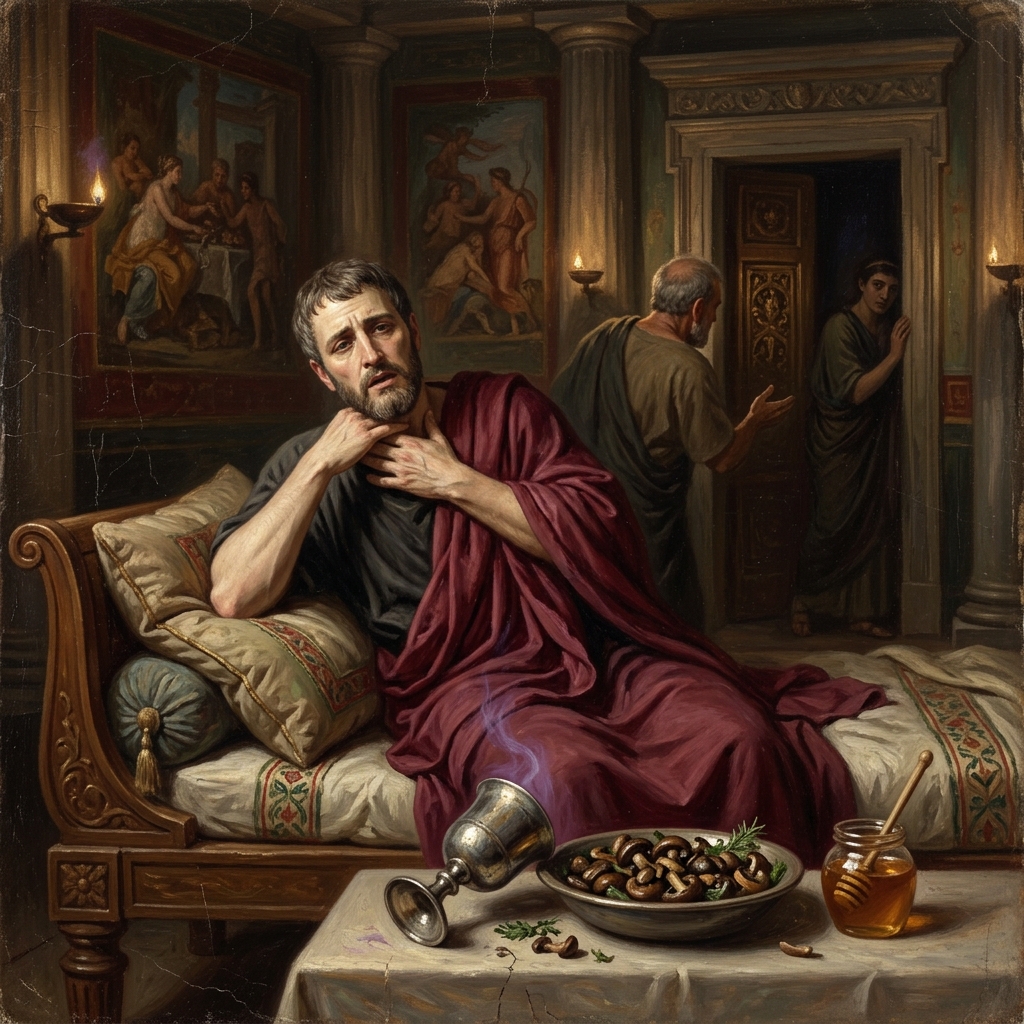
Agrippina the Younger, Claudius’s wife and Nero’s mother, is said to have commissioned Locusta to eliminate the emperor. The method: a dish of poisoned mushrooms (boletus). Tacitus reports that the first dose did not take effect quickly enough. The imperial physician Xenophon is then said to have inserted a quill dipped in poison into the throat of the unconscious emperor to complete the deed. Claudius died that night. His symptoms – vomiting, loss of consciousness – were disguised as a natural death. His successor was ready: Nero ascended the throne.
The Death of Britannicus (55 AD)
Just one year later, Emperor Nero is said to have called upon Locusta’s services once more. Britannicus, his half-brother and potential rival for power, was to die. The problem: a taster checked all food and drink. According to sources, Locusta’s solution was ingenious – she mixed the poison into cold water, which was then added to the hot wine that had already been checked. The taster had only tasted the unadulterated wine and remained unharmed.
Suetonius reports that Nero was dissatisfied with the first dose, as it took too long to take effect. He is said to have forced Locusta to strengthen the mixture on the spot until the poison paralysed him instantly. Britannicus collapsed during dinner and died within a very short time. Nero attributed it to an epileptic fit.
Nero’s patronage and Locusta’s end
Following these murders, Nero is said not only to have pardoned the poisoner, but to have actually rewarded her:
- Estates as a personal gift
- Apprentices to train in the art of poison-making
- A sort of tolerated poison-making workshop on the fringes of the court
Even Nero’s suicide potion, which he is said to have carried with him in 68 AD, is sometimes attributed to Locusta – though he ultimately did not use it, but instead allowed himself to be beaten to death. After Nero’s death, Locusta was arrested and executed by Emperor Galba – presumably towards the end of 68 or in the first few days of 69 AD; the exact date is not clearly recorded in the sources. Modern historians sometimes describe Locusta as one of the first documented female serial killers in history – although a distinction must be made between plausible core events and literary exaggeration.
Agrippina the Younger – Empress, mother, alleged poisoner
Agrippina the Younger (15–59 AD) was one of the most powerful women the Roman Empire ever produced. As the great-granddaughter of Augustus, sister of Emperor Caligula, wife of Claudius and mother of Nero, she stood at the centre of imperial power – and at the centre of some of the most serious accusations that ancient historians ever levelled at a woman. Tacitus, Suetonius and Cassius Dio portray her as a scheming poisoner. Modern research takes a critical view of this portrayal.
The poisoning of Claudius
The key act attributed to Agrippina is the death of her husband Claudius in AD 54. She is said to have commissioned Locusta to prepare the fatal mushroom dish. According to the sources, her motive was clear: to secure Nero’s accession to the throne before Claudius could favour his biological son, Britannicus. The accounts vary in their details – some speak of several doses, others of a quill stuck down his throat. What is certain is that Claudius died, and Nero became emperor.
Further allegations
- Rivals and competitors: Rumours blamed Agrippina’s intrigues for the downfall of several rivals at court
- Senators and their wives: Various influential figures are said to have been eliminated by insidious poison in order to secure Agrippina’s network
Agrippina’s own death
Ironically, Agrippina herself fell victim to an assassination attempt – at the hands of her own son, Nero. In 59 AD, he first attempted to kill her by staging a shipwreck near Baiae. When she survived the disaster, he had her beaten to death in her villa. No poison was used in this instance. Modern research increasingly interprets Agrippina less as a demonic poisoner and more as a power-conscious politician in an extremely violent environment, in which men and women alike resorted to any weapon at their disposal.
Other female poisoners and cases of poisoning in the Empire
Locusta and Agrippina are merely the most prominent names. The history of ancient poisoning in Rome includes numerous other cases – from early mass prosecutions to mysterious individual fates.
The poison scandal of 331 BC
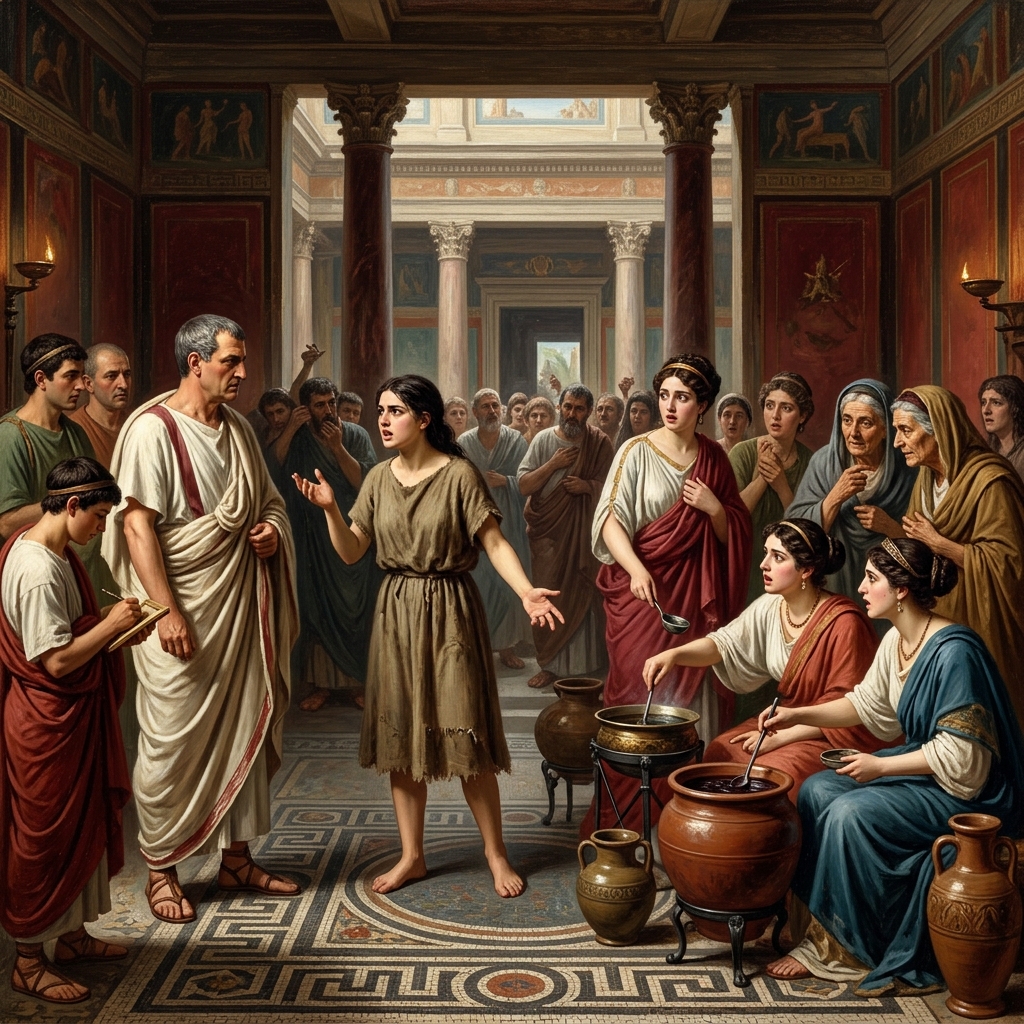
The earliest recorded case of mass poisoning comes from Livy’s *Ab urbe condita*. When numerous prominent men in Rome died in the same year as a rampant epidemic, a slave girl, having been assured of immunity from punishment, revealed an alleged network of women from distinguished families who were working together to produce herbal concoctions. Twenty women were challenged by the witness to drink their own concoctions – they did so and died. The interrogation of their slaves led to the indictment of a total of around 170 further women. It is worth noting that Livy himself expressly expressed doubts about the story in his account and considered it possible that the deaths were in fact simply attributable to the plague and not to poison. The case thus illustrates not so much a proven instance of mass murder as an illuminating mix of social panic, misogyny and political calculation – which was itself critically scrutinised by an ancient historian.
Martina – the Syrian poisoner
Tacitus (Annals 2.74) refers to Martina as a ‘veneficii infamis’ – notorious for poisoning. Around 19 AD, she was suspected of having been involved in the death of Germanicus. She was sent to Rome to testify at the trial of Piso – but died in unexplained circumstances before she could take the stand. Whether she was murdered to prevent her from making unwelcome statements remains unclear.
Fulvia
Fulvia, a noblewoman of the late Republic and wife of Mark Antony, is portrayed by Cassius Dio as a figure of extreme cruelty: According to him, she is said to have placed the head of the murdered Cicero on her lap, pulled out his tongue and pierced it repeatedly with her golden hairpins – in revenge for his speeches against her husband. Although Plutarch’s earlier account mentions that Fulvia mocked and spat on the head, the episode involving the pins is found only in Cassius Dio, who wrote a good 250 years after the events – an indication of how much such details were embellished in the course of oral tradition. Rumours also linked Fulvia to a poisoning, but concrete evidence is lacking, and the entire account is recognisably biased against her.
Quarta Hostilia
Quarta Hostilia was condemned in the 2nd century BC for the death of her husband Calpurnius – essentially on the basis of mysterious circumstances and the suspicion that her reputation had attracted. Concrete evidence or a proven motive are absent from the historical record. The case exemplifies just how little it took in Rome to convict a woman: suspicion, rumour and a dead husband were apparently sufficient.
Poisons and methods: How were people poisoned in Rome?
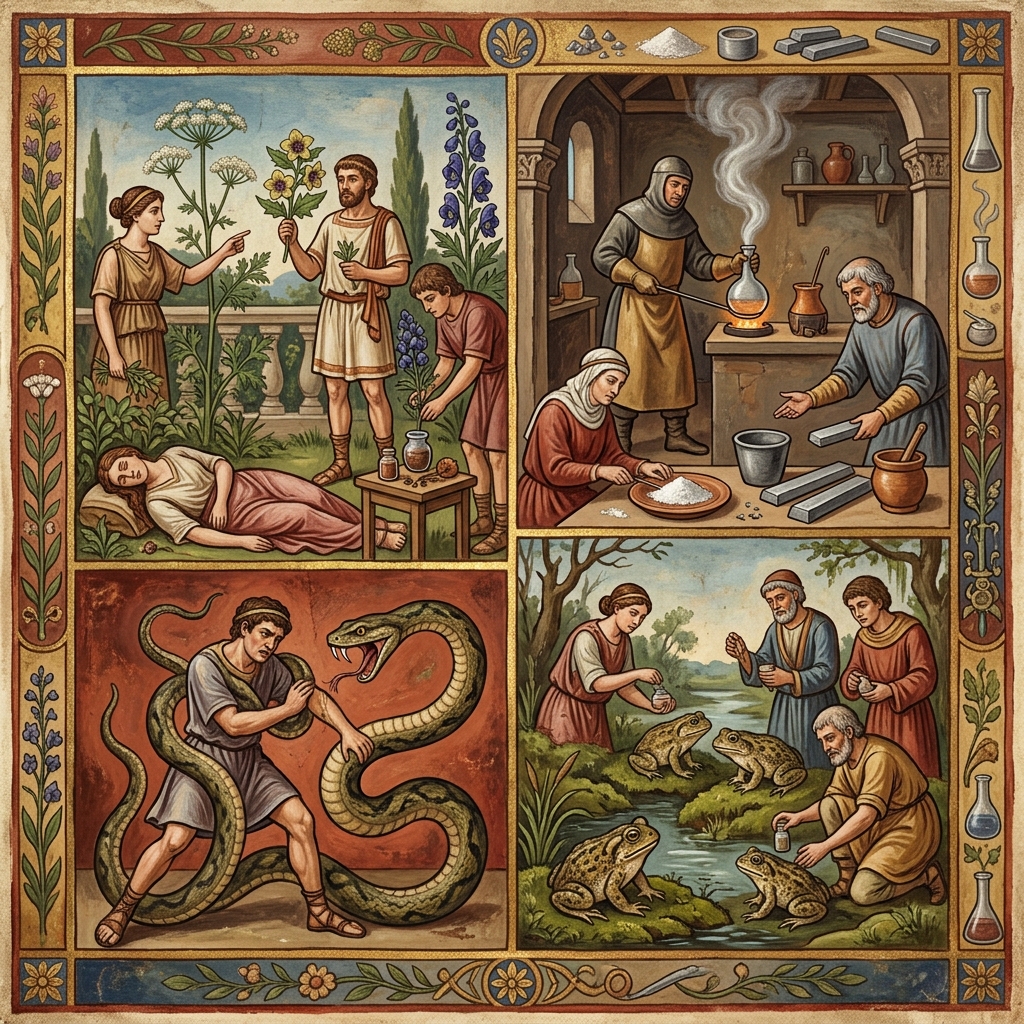
Roman poisoners relied on readily available substances whose effects they knew from experience and tradition. The boundaries between medicine and poison-making were blurred – the same substance could heal or kill, depending on the dose and intention.
Poisons, categories and effects in ancient Rome
| Category | Examples | Effect |
|---|---|---|
| Herbal | Hemlock, henbane, monkshood (Aconitum), opium | Paralysis, convulsions, cardiac arrest |
| Mineral | Lead, mercury, arsenic | Insidious neurological damage |
| Animal | Snake venom, toad venom | Rapid systemic poisoning |
Methods of administration
Poisons were usually administered in food and drink and disguised by strong flavours:
- Wine: The most common vehicle – heavily spiced and therefore easy to tamper with
- Honey: Reliable for masking bitter flavours
- Mushroom dishes: Notorious since Claudius’s death – and difficult to distinguish from genuine mushroom poisoning
- Spiced dishes: Intense flavours masked suspicious notes
Many poisons took effect gradually. Repeated small doses produced symptoms such as stomach cramps, weight loss, fever and heart failure – ailments that mimicked natural illnesses or an epidemic and were almost impossible to distinguish from them without forensic knowledge.
Access and cover
Female poisoners often had legitimate and unsuspected access to their presumed victims:
- As healers and herbalists, whose presence was expected amongst the sick
- As servants with access to the kitchen and insight into daily routines
- As relatives or wives who ate and drank with the victim on a daily basis
Women, Power and Poison: Stereotypes and Reality
In Roman thought, women were closely associated with the domestic sphere, medicinal plants and secret knowledge. This notion fostered the image of the secret poisoner who disposed of her victims under the cover of the home and the kitchen – invisible, silent, elusive.
Venefica and Saga
The terms ‘venefica’ (poisoner) and ‘saga’ (witch) were frequently conflated in literature and law. In Horace’s Satires, Canidia appears as a literary witch figure who uses children’s blood and poison for magic. These texts reflect social fears rather than actual practices – they were moral cautionary tales, not factual accounts.
Political exploitation
Many charges against women for poisoning were politically motivated. They served to:
- to overthrow or discredit powerful empresses
- To strip senators’ wives of their power
- To eliminate unwelcome relatives or rivals
Male poisoners – doctors, slaves, servants – also feature in the sources, but were far less embellished in literary accounts. The collective memory of antiquity was noticeably shaped by gender stereotypes.
Modern assessments
Historians today broadly distinguish between three categories:
- Real-life legal cases: Locusta, Martina, documented trials with verdicts
- Moral cautionary tales: Canidia, the literarily exaggerated Agrippina
- Propagandistic exaggerations: hostile sources such as parts of Tacitus’s work
Research increasingly emphasises that allegations of poisoning often reveal more about the mistrust of influential women in a patriarchal society than about actual crimes.
Aftermath: Rome’s female poisoners in literature, opera and research
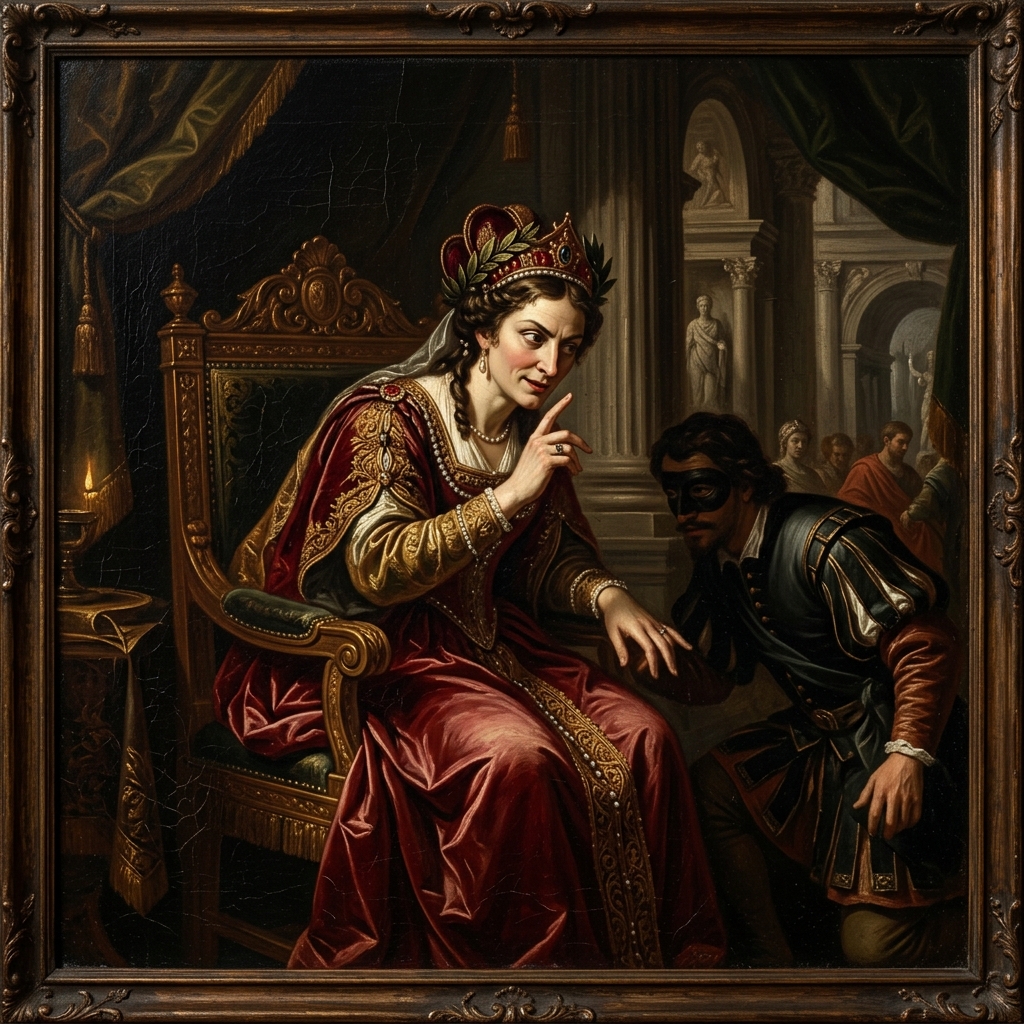
Roman female poisoners continue to capture the imagination to this day – from the Renaissance through the early modern period to contemporary true-crime formats. Hardly any figure from antiquity combines fascination and horror as effectively as Locusta or Agrippina.
The Early Modern Period and the Middle Ages
Since the Middle Ages, Locusta has been portrayed in chronicles as the archetype of the cold-blooded poisoner. Such figures also served to warn against female depravity and the supposedly dangerous knowledge of herbs and poisons – a motif that later also found its way into the witch hunts of the early modern period.
Opera and Theatre
Agrippina appears in George Frideric Handel’s opera of the same name (libretto: Cardinal Vincenzo Grimani, premiered on 26 December 1709 at the Teatro San Giovanni Grisostomo in Venice) as an scheming, power-hungry empress. The libretto portrays her as far more demonised than the ancient sources would justify – and turns this into great theatre. With 27 consecutive performances at its premiere, the opera became one of Handel’s greatest early successes and remains in the repertoire to this day.
Modern research
Recent historical research has consistently sought to distinguish political propaganda and literary tropes from actual events. Historicians such as Anthony Barrett emphasise the possibility that many allegations of poisoning were retrospective scandal narratives – concocted by men who feared powerful women or sought to harm their political opponents. The path to a nuanced historical picture lies in critical source analysis and the realisation that history is always written by those who had the power to record it.
Frequently asked questions about ancient poisonings in Rome
Were poisonings in ancient Rome really as common as the sources suggest?
Ancient authors probably greatly exaggerated the incidence of poisonings – particularly during times of political crisis and in the event of sudden deaths amongst the elite. The actual frequency is difficult to determine, as natural causes of death and poisoning could not be reliably distinguished without forensic evidence. Poisoning was also a popular literary motif used to morally discredit political opponents or powerful women.
Which emperors might have died from poisoning?
Frequently discussed cases include:
- Claudius (54 AD): Poisoned mushrooms; Locusta as the alleged perpetrator; Agrippina as the instigator
- Britannicus (55 AD): Poisoned wine, again Locusta, with Nero as the instigator
- Tiberius (37 AD): rumours of Caligula’s involvement, though historically disputed
- Domitian (96 AD): Speculation without a solid basis in sources
Modern historians are cautious: there is no scientific evidence to confirm that any Roman emperor was murdered by poisoning. Most of the allegations first appear in later, hostile sources.
How did people distinguish between illness and poisoning in those days?
Doctors such as Scribonius Largus and Galen made judgements based on symptoms – vomiting, convulsions, paralysis. There were no autopsies in the modern sense, nor any chemical analysis. Diagnoses were subjective and shaped by expectations: if someone was to die, poisoning was suspected. Suspected cases were decided in court – through witness statements, confessions extracted under torture, and the reputation of the accused.
Were there also male poisoners in the Roman Empire?
The Lex Cornelia explicitly covered all poisoners – men and women, freemen and slaves alike. The sources mention male doctors, slaves and servants who are said to have administered poison on behalf of others. The personal physician Xenophon, for example, was accused of complicity in the death of Claudius. However, male perpetrators were portrayed in the historical record in a far less sensationalised manner – which is why the memory of poisoning in Rome has remained so heavily associated with women.
How reliable are the accounts of Locusta and Agrippina?
Our main sources – Tacitus, Suetonius, Cassius Dio – wrote decades or even centuries after the events and were motivated by both political and moral considerations. Precise dialogues, sensational details and dramatic escalations are often literary embellishments, as the example of the Fulvia episode demonstrates. Historians today distinguish between plausible core events (Claudius’s death, Locusta’s existence and activities) and later scandalous accounts. The path to a more realistic picture lies in critical source analysis – not in blind trust in ancient historians.


