Everyone is familiar with the scene from the film: the emperor in the stands raises his arm, points his thumb downwards, and the death sentence is sealed. But what do we actually know about the thumbs-up signal in the arena? The answer is surprising: almost certainly nothing. This article reconstructs what the ancient sources really tell us – and shows just how much a single 19th-century painting has shaped our entire conception of gladiatorial combat.
What to expect in this article
- Key findings at a glance
- Introduction: The myth of the thumbs-up and thumbs-down
- Historical background: Gladiatorial combat and decision-making rituals
- Pollice verso in ancient sources
- Research hypotheses: What did the thumb actually mean?
- Jean-Léon Gérôme and the invention of the ‘thumbs down’
- Beyond the Gesture: The Reality of Everyday Life for Gladiators
- FAQ: Frequently asked questions about ‘pollice verso’ and the thumb in the arena
 Reading time approx. 9 mins.
Key findings at a glance
- Pollice verso literally means ‘thumb turned’ – the exact manner of the gesture is not clearly described in ancient literature and does not specify a direction (neither ‘up’ nor ‘down’).
- The popular notion that ‘thumb down = death’ is not based on ancient sources, but was largely shaped by the painting ‘Pollice Verso’ by Jean-Léon Gérôme (1872, oil on canvas), which now hangs in the Phoenix Art Museum.
- This interpretation was popularised primarily by Hollywood – in particular through films such as Ridley Scott’s ‘Gladiator’ (2000), which was demonstrably inspired by Gérôme’s painting.
- Gladiators were economically valuable fighters; the final decision regarding a gladiator’s life rested with the emperor or the organiser of the games, not solely with the audience.
- Ancient sources contain only a few references to the thumb, and even their exact meaning remains a matter of debate amongst scholars.
Introduction: The myth of the thumbs-up and thumbs-down
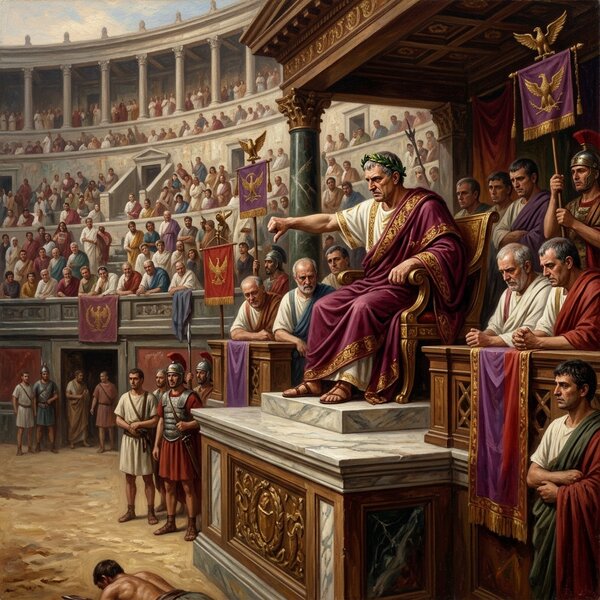
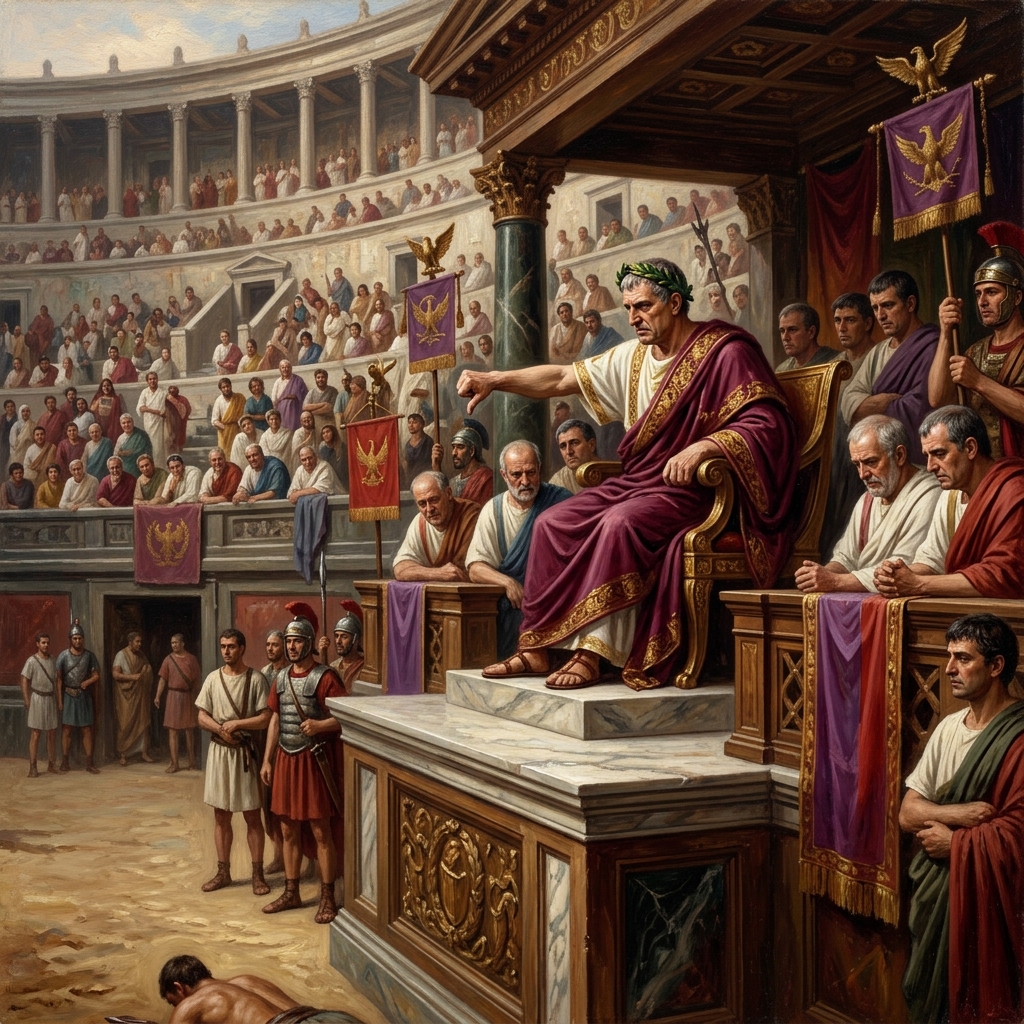
Imagine the Emperor’s box: Commodus gazes down at the defeated man at the bottom of the arena, the crowd is in a frenzy, and a single gesture of the hand decides life or death. This is how it is portrayed in the film *Gladiator*, with Maximus as the hero. Whether in Hollywood, in comics such as *Asterix*, or in the popular imagination – the gesture ‘thumbs up = mercy, thumbs down = cut his throat’ is treated as historical fact.
In fact, the question of what the thumb really signified during gladiatorial combat has been the subject of intense debate since the 19th century. Ancient sources provide hardly any clear descriptions of the gestures. Key terms include:
- Pollice verso – ‘with the thumb turned’ (direction unknown)
- Missio – pardoning the defeated gladiator
- Iugula – a call to kill
- Pollicem premere – ‘pressing the thumb’ (presumably a gesture of mercy)
Historical background: gladiatorial combats and rituals of decision
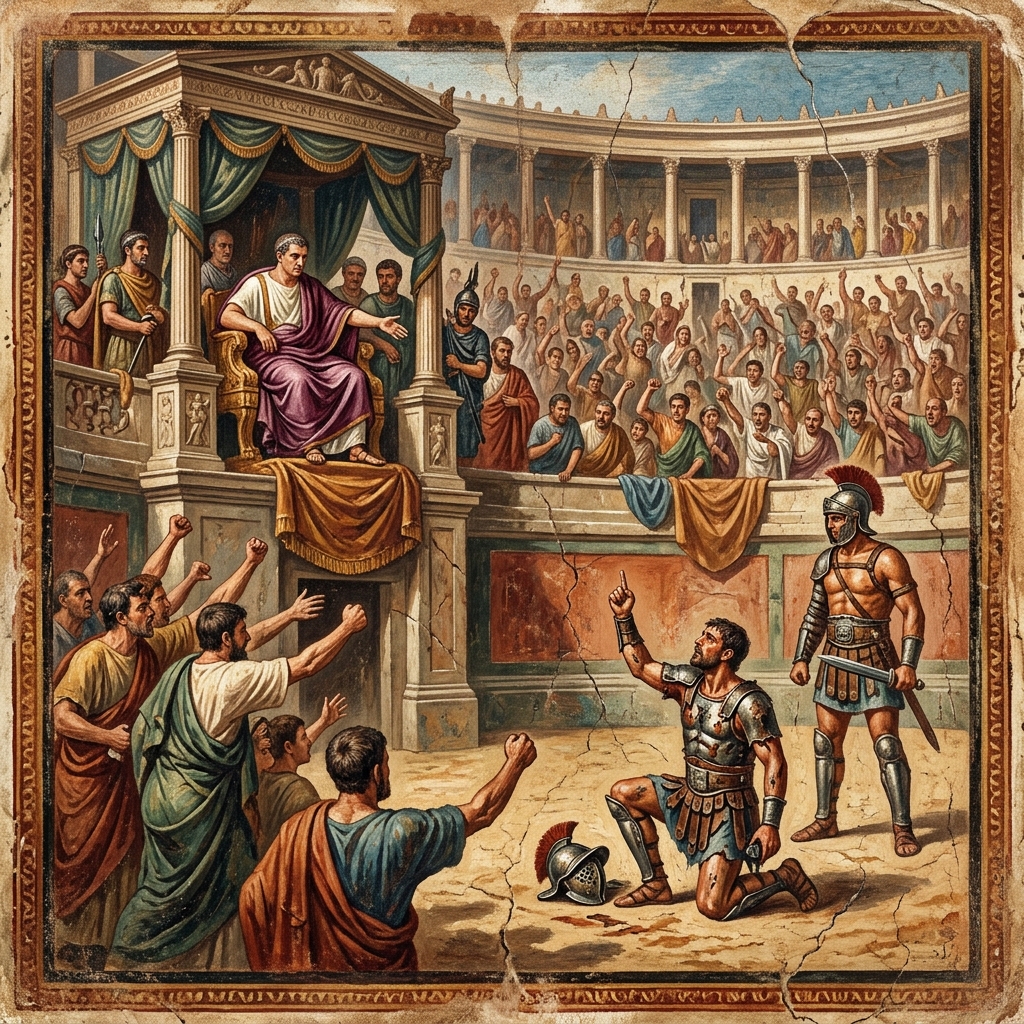
The origins of gladiatorial games are, in fact, a matter of debate amongst scholars. For a long time, an Etruscan origin was considered likely – derived from the custom of offering human sacrifices upon the death of a nobleman. However, Etruscan depictions tend to show fights between humans and animals rather than duels between equally armed combatants. The Roman historian Livy instead traced the origin to Campania, where tomb paintings do indeed depict duelling scenes; a third theory, which has gained traction in recent times, points to Samnite origins, as the earliest gladiators appeared with typical Samnite armament. The word ‘lanista’ (gladiator trainer) is traditionally interpreted – for example by the late-antique scholar Isidore of Seville – as an Etruscan loanword for ‘executioner’; however, modern linguists doubt this derivation and also discuss Indo-European roots.
What is firmly established, however, is the first documented *munus* in Rome: in 264 BC, the brothers Marcus and Decimus Junius Brutus had three pairs of slaves fight each other on the Forum Boarium in honour of their late father. During the Imperial period, particularly following Augustus’s reforms in the 1st century AD, the games developed into major political spectacles – with the Colosseum under Emperor Titus (80 AD) representing their architectural pinnacle.
Gladiators were mostly slaves or convicted criminals; less commonly, they were adventurous free Romans seeking glory in the arena. Their training in the ludus, the gladiator school, was expensive – a compelling economic argument against routine killings. A defeated gladiator would raise his index finger (‘ad digitum’) to beg for mercy. The audience would then react – but the final decision lay with the munerarius, the organiser, or with the emperor present. Social pressure, political calculation and the spectacle-driven logic of the games all came into play here.
‘Pollice verso’ in ancient sources
The expression ‘pollice verso’ is attested in only a few ancient texts, and not a single passage describes the exact hand position.
Juvenal writes in his third satire (early 2nd century AD) that the crowd decided on the gladiator’s life or death by turning their thumb (“verso pollice”) – without specifying the direction. The late-antique Christian poet Prudentius uses the expression ‘converso pollice’ in the second book of his polemic ‘Contra Symmachum’ (late 4th century AD): In it, he offers a sharply critical account of how a Vestal Virgin cheers at every fatal blow and, by turning her thumb, signals the final thrust – here too, it remains unclear exactly how the thumb was positioned. In his treatise on rhetoric, *Institutio Oratoria* (Book XI), Quintilian describes a ‘pollice infesto’ (hostile thumb) – though explicitly as a gesture used by public orators, not in the arena; it is only in later texts, such as the *Anthologia Latina*, that the same phrase is applied to the Colosseum. Pliny the Elder mentions in his *Natural History* (Book XXVIII) the gesture ‘pollices premere’ as a general sign of goodwill – presumably by pressing the thumb against the fist or the index finger.
What the sources show overall:
- ‘Verso/converso/infesto’ describes a ‘twisted’ or ‘hostile’ thumb – never explicitly ‘downwards’
- ‘Pollices premere’ appears in independent texts as a gesture of goodwill or pardon
- No surviving ancient pictorial representation clearly shows a ‘thumb down’ as a signal of death
- The descriptions remain vague in all cases; any indication of direction is completely absent
- Translations and interpretations by modern researchers therefore vary considerably
Research hypotheses: What did the thumb actually mean?
There is no absolute certainty, but the most influential modern analysis comes from the classical scholar Anthony Corbeill, who deals extensively with Roman gestures in his book *Nature Embodied: Gesture in Ancient Rome* (2004).
Corbeill’s theory: what mattered was not whether the thumb was pointing up or down, but whether it was visibly extended or pressed into the fist. An openly displayed, ‘hostile’ thumb (infestus pollex) signalled a wish for death, whilst a thumb pressed against the fist (pollex pressus or pollicem premere) signified mercy. This would mean that, if Corbeill is correct, today’s convention – thumb up for ‘good’, thumb down for ‘bad’ – may well have been almost the reverse of Roman practice, in which it was precisely the visibly extended thumb that signalled a death sentence. This interpretation also makes practical sense: across the vast distance of the arena, a thumb turned ‘up’ or ‘down’ would have been barely discernible, whereas a visibly extended thumb, as opposed to a concealed one, would certainly have been.
A distinct minority view amongst scholars goes even further, suggesting that a thumb pointing downwards may originally have signified mercy – as a symbol of sheathing the sword. This interpretation directly contradicts modern cinematic logic and finds little support in the specialist literature, but it does illustrate just how uncertain the source material is overall.
Important: The thumb gesture was never used in isolation anyway. Shouts from the audience, the waving of cloths (mappae) and the decision of the match official complemented every gesture. A single thumb signal alone did not determine life or death.
Jean-Léon Gérôme and the invention of the ‘thumbs down’
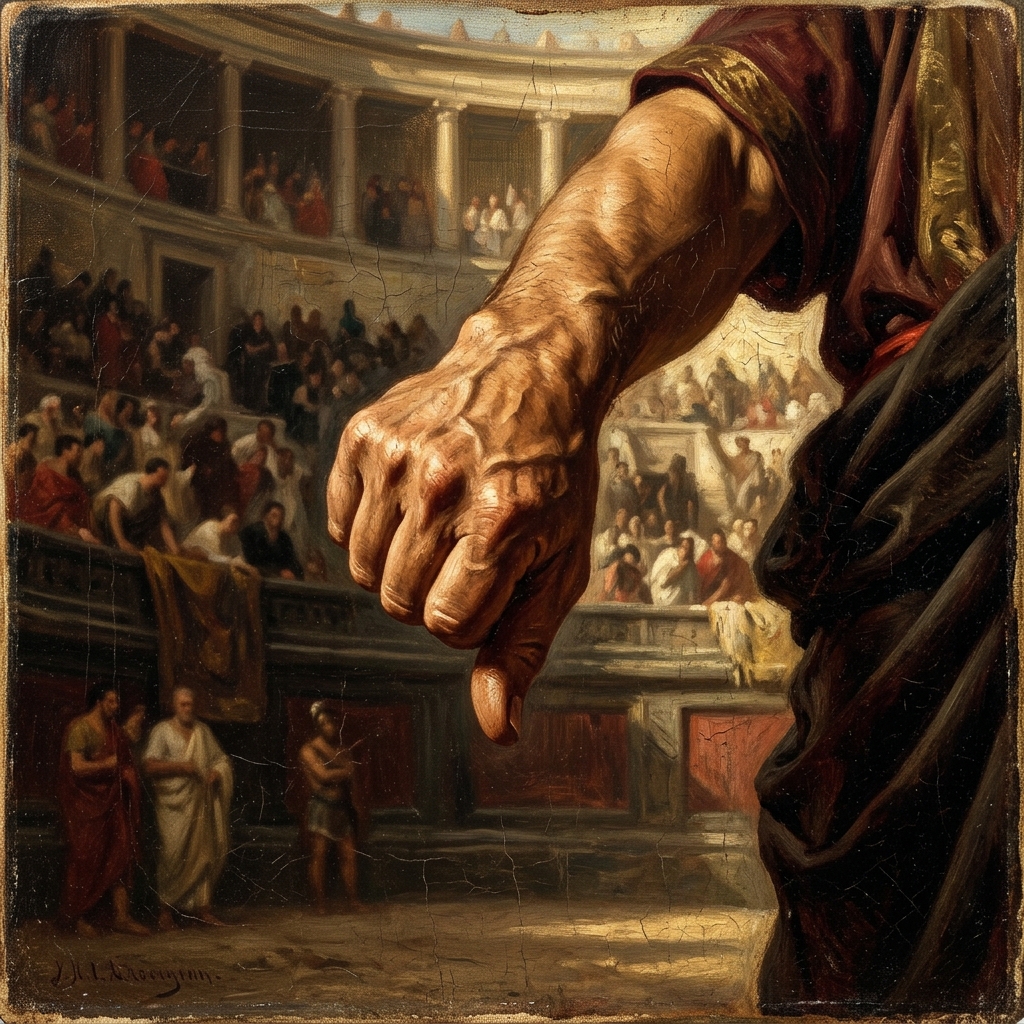
In 19th-century Paris, the ancient world fascinated academic painting. In 1872, the painter Jean-Léon Gérôme created the painting that was to shape our imagination forever: ‘Pollice Verso’, oil on canvas, now in the Phoenix Art Museum in the USA. The painting depicts a thumbs-down gesture as a death sentence – a deliberate, dramatic staging with no ancient precedent.
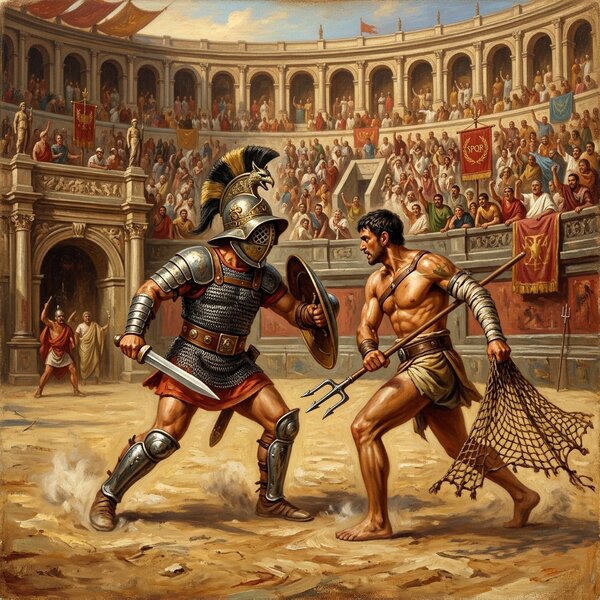
The scene: a victorious murmillo stands over the defeated retiarius on the ground, who raises two fingers to beg for mercy. Vestal virgins in the stands extend their arms with thumbs turned downwards; the emperor himself is also visible. Gérôme’s depiction – which the New York merchant Alexander Turney Stewart bought from the artist at the time for the record sum of 80,000 francs – became the model for countless later paintings, theatre productions and, ultimately, films.
The influence of Gérôme’s *Pollice Verso* extends to the present day:
- It established the visual convention ‘thumb down = death’ in popular culture
- It shaped theatre productions and book illustrations of the late 19th century
- Ridley Scott was demonstrably inspired by Gérôme’s painting when developing the visual concept for *Gladiator* (2000)
- Earlier epic films such as ‘Ben-Hur’ also drew on similar visual motifs
- Through cinema, the myth eventually became known worldwide
Beyond the gesture: the reality of a gladiator’s daily life
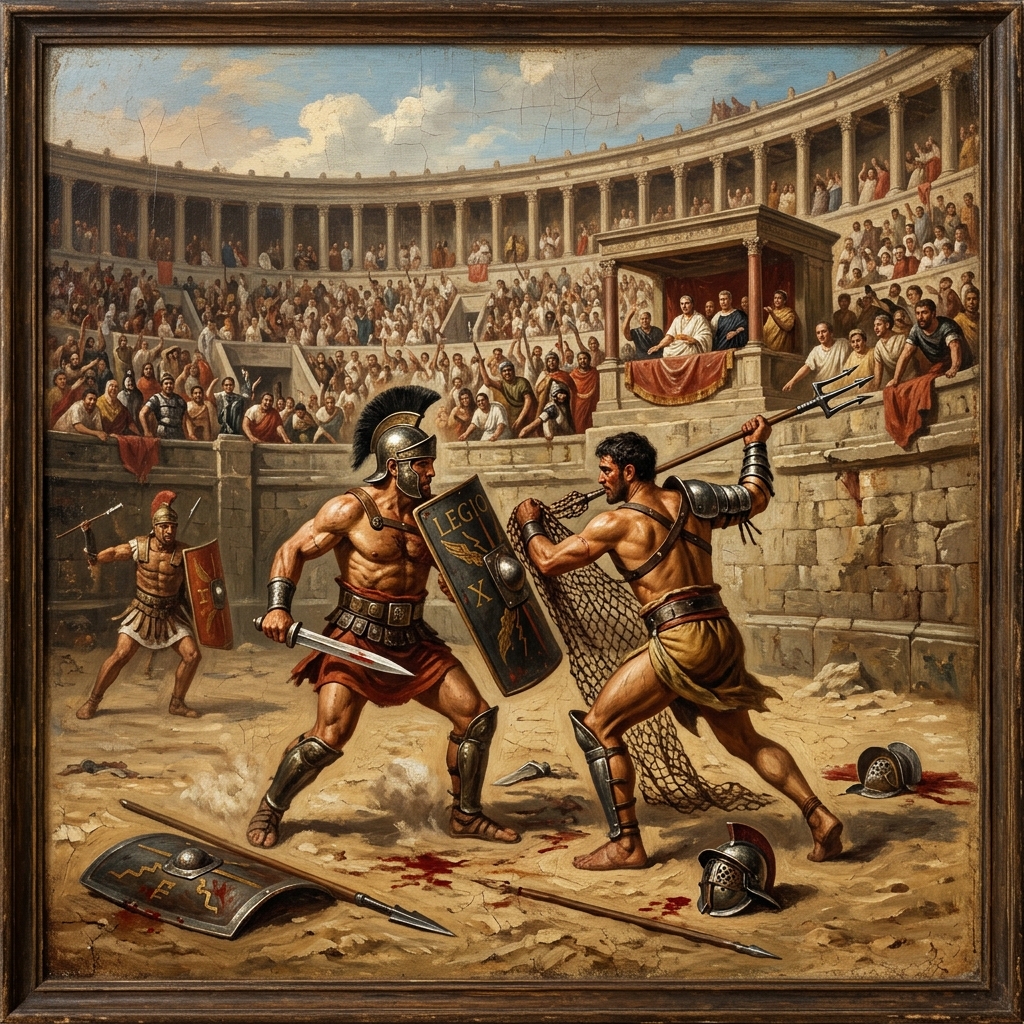
The debate surrounding the ‘pollice verso’ gesture often focuses on a single dramatic moment and overlooks the everyday lives of gladiators. Inscriptions and gravestones show that many fighters survived several duels over the course of years. Modern historians estimate the mortality rate per fight to be well below 50 per cent.
From an economic perspective, another factor was decisive: gladiators were expensive investments. Their training, upkeep and the status of a successful fighter as a crowd-puller made them valuable. Constant killings would have ruined the lanistae financially. The games also served as an instrument of power – ‘panem et circenses’ – in which the organiser staged a display of ostentatious generosity. Fights ‘sine missione’ (without any possibility of mercy) were the rare exception, not the rule. The voice of the audience certainly played a part, but it was embedded within fixed rituals and was not a completely arbitrary whim of the moment.
FAQ: Frequently asked questions about ‘Pollice Verso’ and the thumb in the arena
Was the thumb really the only or most important signal in the Colosseum?
No. Alongside the thumbs-up gesture, shouts from the audience, the waving of cloths (mappae), acoustic signals and, above all, the decision of the munerarius played a central role. Contemporary visual sources such as mosaics and reliefs show hardly any thumb gestures, but rather battle scenes, weapons and signs of victory. Fights ‘sine missione’ were dictated by the programme and left no scope for spontaneous gestures.
Were there differences in gestures between Rome and the provinces?
The evidence regarding regional differences is extremely scarce. Most of the surviving texts originate from Rome or Italy. Local customs in North Africa or in the eastern part of the empire may have supplemented the basic rituals, but a reliable reconstruction is not possible. Archaeological finds from amphitheatres in the provinces do show depictions of gladiators, but no clear gestures.
Since when exactly has the notion of ‘thumb down = death’ existed?
A few early modern authors mention vague gestures, but the iconic association only emerged in 1872 with Jean-Léon Gérôme’s painting. Through prints, theatre productions and later the cinema, this interpretation spread worldwide. Before Gérôme’s painting, there was no established popular interpretation – it was his work alone that turned the thumbs-down gesture into what appears to be a historical fact.
How accurate is the film *Gladiator* with regard to the thumbs-down gesture?
‘Gladiator’ (Ridley Scott, 2000) was meticulously researched in many details, but deliberately follows the Gérôme tradition when it comes to the thumb gesture. The character Commodus uses the gesture as an instantly recognisable symbol for cinema audiences. The film offers a modern interpretation of the atmosphere of antiquity, not an exact reconstruction of historical ritual gestures.
Why is the debate surrounding pollice verso important to historians in the first place?
It is not just about a hand gesture, but about fundamental questions: how did violence function as a public spectacle? What power did the audience really have? The debate shows just how strongly our perceptions of history are shaped by art and popular culture – and how important critical source analysis remains, particularly when it comes to phenomena such as bodily gestures, for which there is hardly any material evidence.


Letters from the trading house
New arrivals, market dates and offers, straight from Rinchnach. Unsubscribe any time with one click.
Subscribe to the newsletter