Freyja is one of the most fascinating figures in Norse mythology. Her name literally means ‘Lady’ – a title that unmistakably signals her position of power amongst the gods; many scholars even believe that ‘Freyja’ was originally an epithet that replaced a proper name which has not been handed down to us today. As a goddess, she embodies love, passion, sensuality and fertility to an extent that goes far beyond romantic idyll. She hails from the Vanir clan, but following the Vanir-Aesir War, she lives amongst the Aesir in Ásgarðr. In human life, she played a role in marriage, sexuality and childbirth, as well as on the battlefields, where she selected the fallen. This article explores her origins, family, symbols, key myths and her significance for people today.
What to expect in this article
- Key insights at a glance
- Introduction: Freyja as the goddess of love, beauty and fertility
- Origins, family and role in the pantheon of gods
- Attributes, symbols and depictions of Freyja
- Freyja as the goddess of love and fertility
- Freyja in mythology: key legends and themes
- FAQ on Freyja – Goddess of Love
 Reading time approx. 7 mins.
Key facts at a glance
- Freyja is the goddess of love, beauty and fertility in Norse mythology – yet she also embodies war, death and magic in a single figure.
- As a master of Seiðr sorcery, she taught Odin himself this powerful art and selects half of the fallen warriors for her hall, Fólkvangr.
- The Poetic Edda and Snorri’s Prose Edda (both recorded in writing in the 13th century) are the key sources that continue to shape our image of Freyja to this day – although individual episodes, such as the theft of Brísingamen, originate from even later Icelandic texts.
- Freyja’s themes – desire, loss, passion, strength – continue to influence art, literature and modern spirituality worldwide to this day.
Introduction: Freyja as the goddess of love, beauty and fertility
Freyja is one of the most fascinating figures in Norse mythology. Her name literally means ‘Lady’ – a title that unmistakably signals her position of power amongst the gods; many scholars even believe that ‘Freyja’ was originally an epithet that replaced an actual name which has not been handed down to us today. As a goddess, she embodies love, passion, sensuality and fertility to an extent that goes far beyond romantic idyll. She hails from the Vani clan, but following the Vani-Aesir War, she lives amongst the Aesir in Ásgarðr. In human life, she played a role in marriage, sexuality and childbirth, as well as on the battlefields, where she selected the fallen. This article explores her origins, family, symbols, key myths and her significance for people today.
Origins, Family and Role in the Pantheon
Freyja’s family history anchors her deeply in the world of the Vanir gods – an ancient lineage associated with nature, water and prosperity.
Her father is Njörðr, a god of the sea and trade. Her brother Freyr represents fertility, harvest and rain. The identity of her mother remains unclear in the sources; some researchers link her to the Nerthus tradition, as, according to a theory by Rudolf Simek, Nerthus and Njörðr may originally have been closely related or even one and the same deity – an idea which, via the parent-child relationship, also sheds light on Freyja’s origins, though it ultimately remains speculative. Freyja’s marriage to Óðr is a motif steeped in longing: when he disappears, she sheds tears of red gold. Her two daughters are called Hnoss and Gersemi – both names mean ‘treasure’ or ‘jewel’.
Following the peace treaty between the Vanir and the Aesir, Freyja moved to Ásgarðr, where her residence, Fólkvangr – a place that can be translated as ‘Fields of the People’ – is situated. There, in the hall Sessrúmnir, she receives half of the warriors who have fallen in battle. Unlike Odin’s Valhalla, Fólkvangr is a realm over which Freyja herself reigns. She also teaches Seiðr magic – a form of divination, healing and transformation which, according to the Ynglinga Saga by the Icelander Snorri Sturluson, she passed on from the Vanir to the Aesir and ultimately to Odin. She thus occupies a central position within the entire pantheon: as a bridge between families of gods, between love and war.
Attributes, symbols and depictions of Freyja
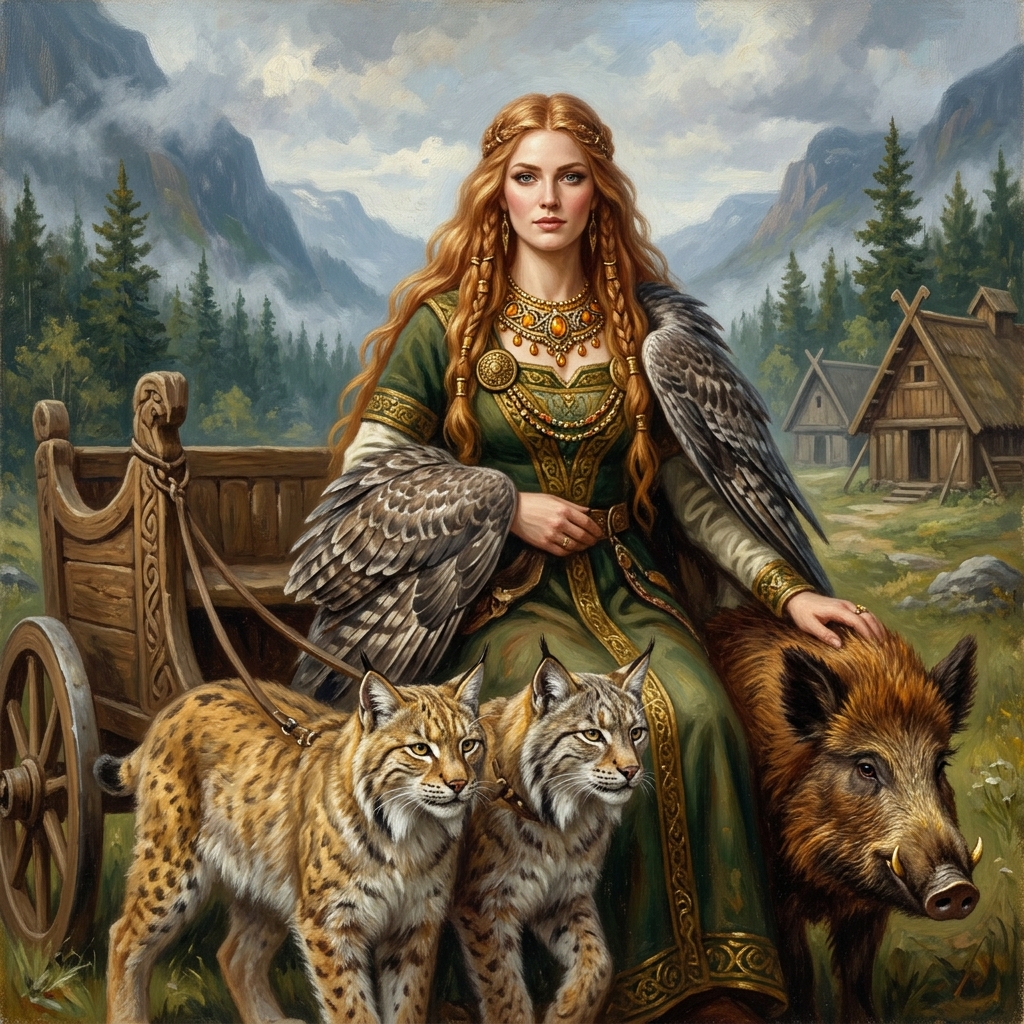
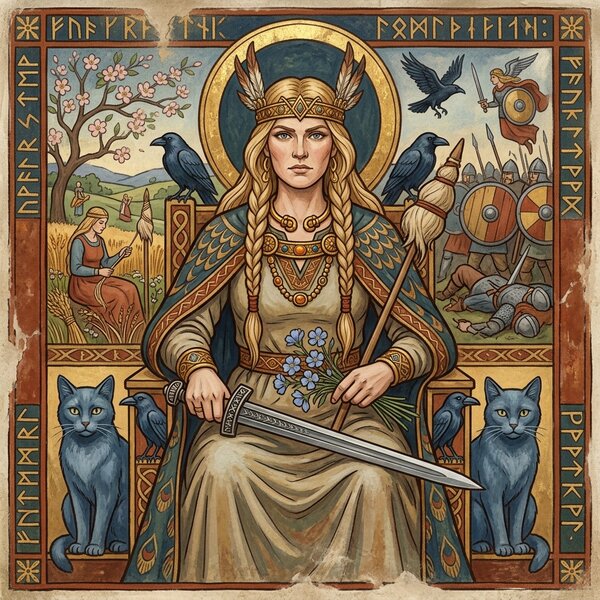
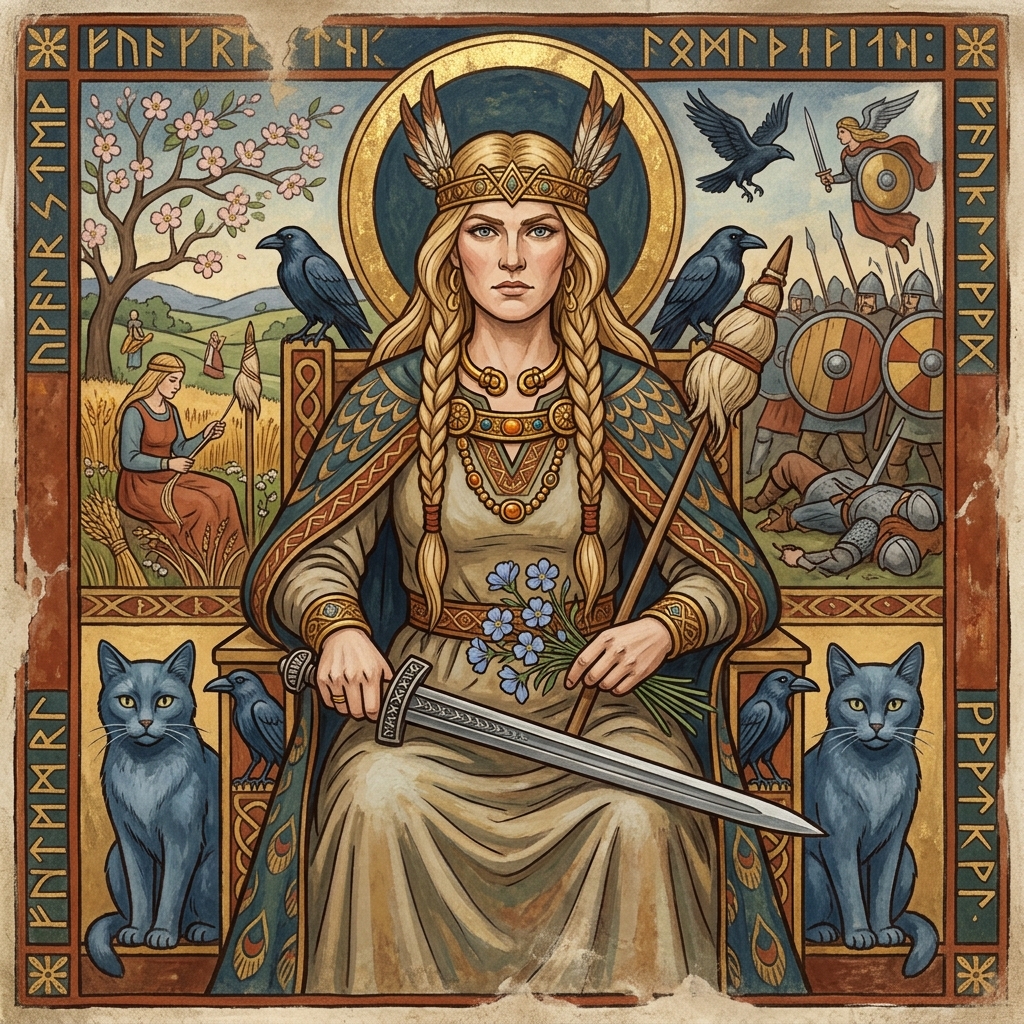
Freyja’s symbols reflect her multifaceted nature. Each attribute tells its own story of power, beauty and danger.
- Brísingamen: According to the tale *Sörla þáttr* – a text first recorded in the 14th century in the manuscript *Flateyjarbók*, and thus a significantly later source than the *Edda* poems themselves – this precious necklace was fashioned by four dwarves. Freyja must pay a high price for it, the exact terms of which are depicted with varying degrees of openness depending on the retelling. Loki subsequently steals it on Odin’s behalf by transforming himself into a fly. The necklace symbolises desire and feminine power.
- Cat-drawn chariot: Freyja rides in a chariot drawn by two large cats. These animals represent independence, wildness and sensuality – befitting a figure who values freedom above all else.
- Falcon Cloak: With this feathered cloak (Fjaðrhamr), one can transform into a falcon and travel between the worlds. Loki, in particular, borrows it from Freyja in several tales – for example, in the Þrymskviða, to track down Thor’s stolen hammer, and in the story of the abduction of the goddess Iðunn.
- Hildisvíni: Her golden wild boar combines the symbolism of war with fertility – in many cultures, pigs represent both abundance and raw power.
- Golden tears: When Óðr is absent, Freyja weeps gold – an image that blends loss, longing and material value.
In depictions in 19th- and 20th-century Scandinavian art, Freyja often appears as a beautiful yet armed woman. She is frequently depicted in gold, which bathes the atmosphere of her myths in a warm light.
Freyja as the goddess of love and fertility
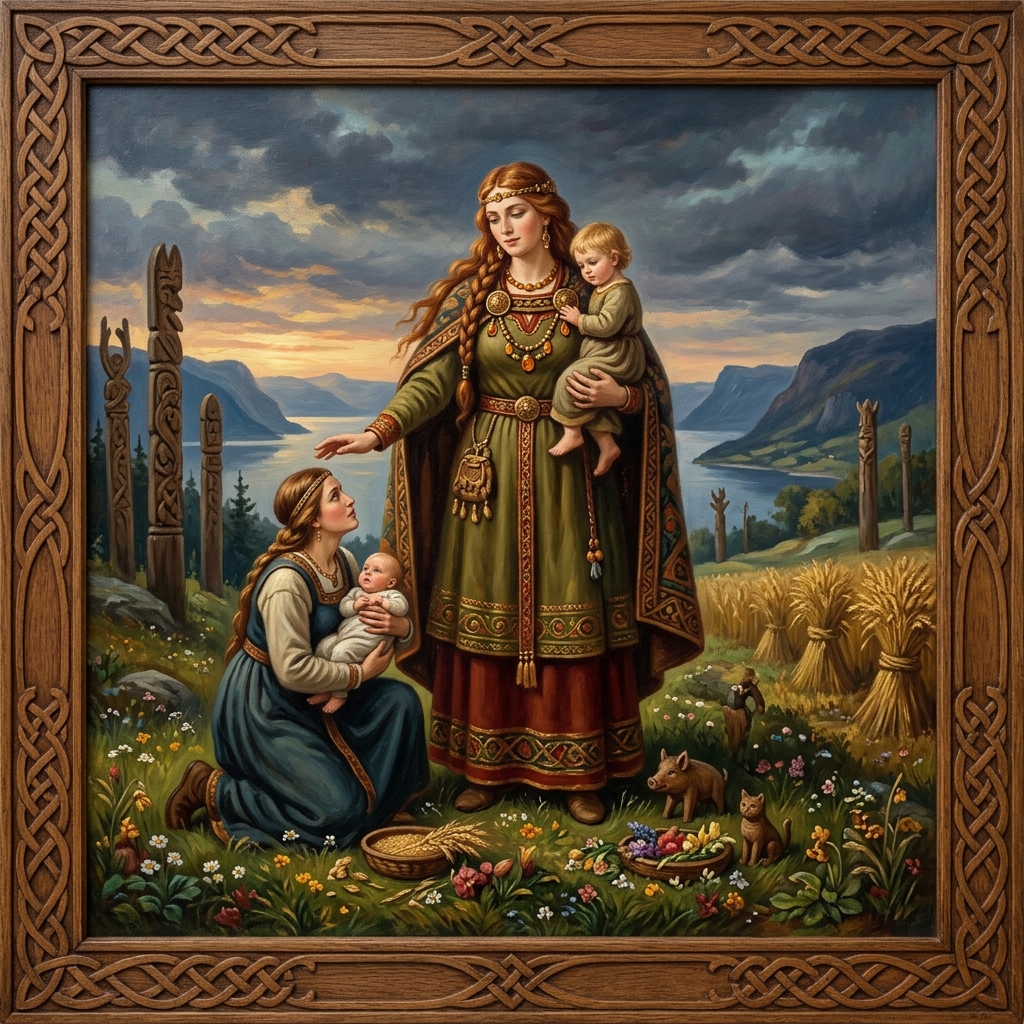
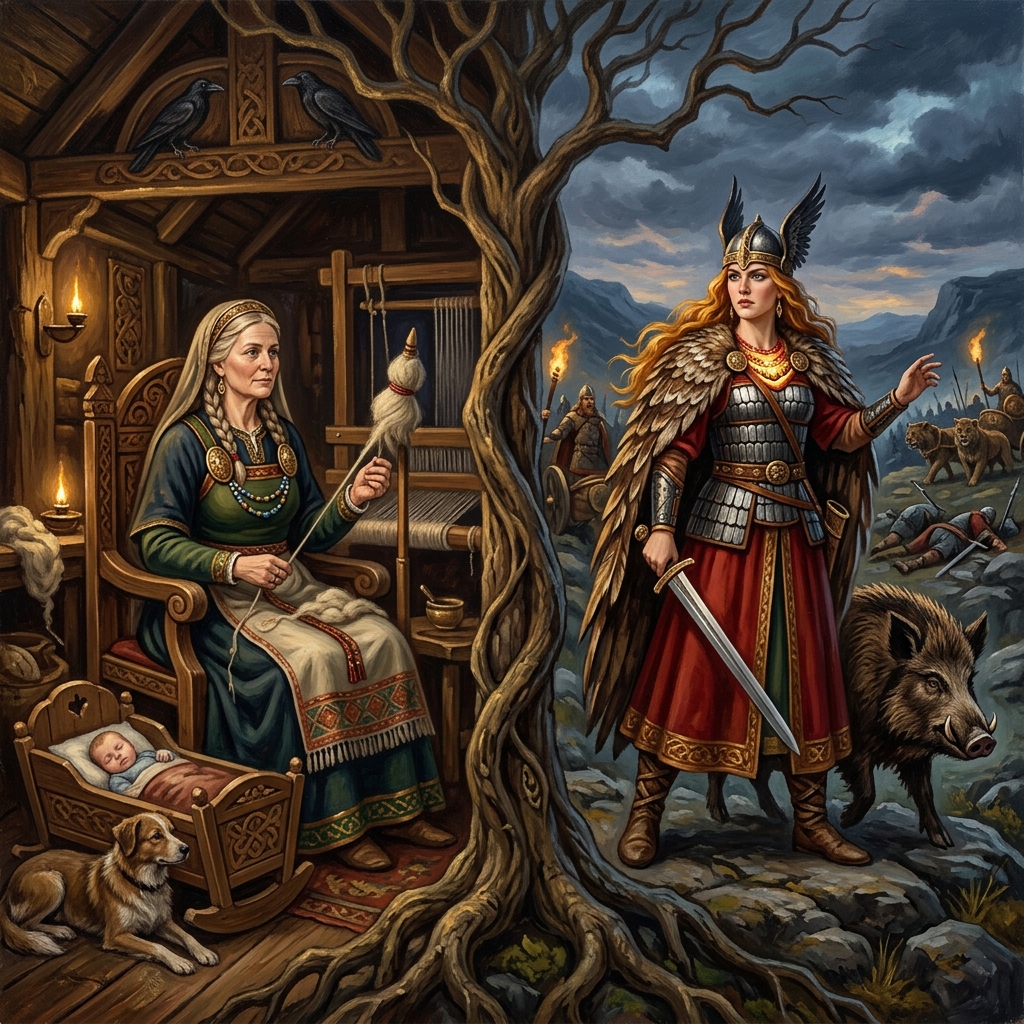
Freyja embodies human emotions in all their intensity: love, desire, jealousy, grief. She is not a gentle idyll, but a force that permeates people’s lives.
As the patron goddess of eroticism, marriage and partnership, her influence extended beyond the realm of romance. Women invoked her when wishing for children, during childbirth and to ensure the fertility of the soil. In Norse societies, whose survival depended on harvests, livestock and offspring, this was a matter of survival.
Ambivalence is central to this: Freyja’s love is passionate and free, yet her grief over the loss of Óðr shows that passion also brings pain. In the Vikings’ view of humanity, sexuality and love were natural, powerful forces – sources of happiness, but also of doom.
Today, neo-pagan movements – in Scandinavia, Europe and the USA – revere Freyja as a symbol of female self-determination and emotional authenticity. Compared with goddesses of love from other cultures, such as the Mesopotamian Ishtar, whose cult spread across the Near East as far as Syria, or the Greek Aphrodite, Freyja displays a striking combination of tenderness and a readiness for war – a combination that is rarely so clearly pronounced in other goddesses of love.
Freyja in mythology: key legends and motifs
The most important texts concerning Freyja come from Icelandic manuscripts, the majority of which were written down in the 13th century. The Poetic Edda and Snorri’s Prose Edda provide the key information on her myths; individual episodes, such as the theft of Brísingamen, are only recorded in later texts from the 14th century.
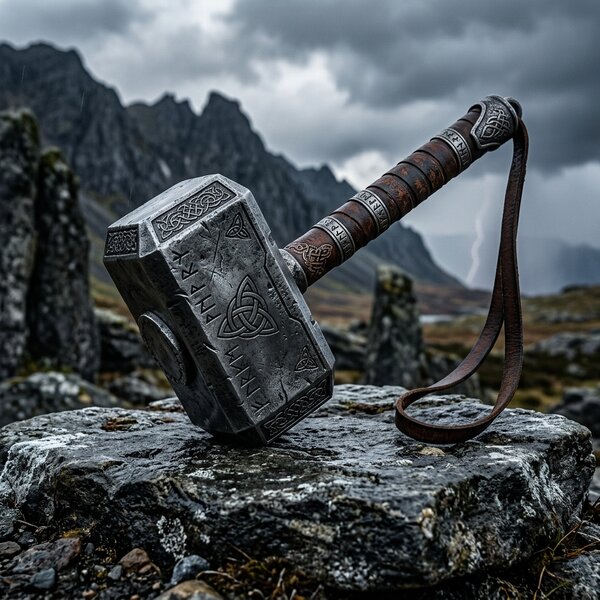
Þrymskviða: The giant Þrymr steals Thor’s hammer and demands Freyja as his bride. Freyja refuses indignantly and categorically – her anger causes Brísingamen to shatter. Thor then disguises himself as a bride in order to retrieve the hammer. The poem combines love, deception and humour in a unique way. It shows that Freyja is not a passive trophy, but a goddess with a will of her own.
The Brísingamen myth: Freyja’s acquisition of the necklace and its subsequent theft by Loki raise questions about desire, trade and power. The ideas behind them reflect a cross-cultural tension that Rudolf Simek discusses in detail in his encyclopaedia of Germanic mythology.
Seiðr magic: According to the Ynglinga Saga, Freyja first teaches the Vanir, then the Aesir, and finally Odin himself this art of magic, which encompasses divination, curses and healing – a path that transcends the boundaries between life and death. Men who practised Seiðr were denounced as ‘ergi’ (unmanly) in Old Norse texts such as the Lokasenna – in that text, Loki even levels this very accusation at Odin himself, which underlines the social controversy surrounding this practice.
Selection of the Fallen: Freyja selects half of the warriors who have fallen on the battlefields for her hall, Fólkvangr; the other half enter Odin’s Valhalla. For this reason, she is regarded as virtually equal in status to Odin – an example of how war and love are inextricably linked in the Norse worldview.
FAQ on Freyja – Goddess of Love
Is Freyja the same as Frigg?
No. In medieval sources, Freyja and Frigg appear as distinct goddesses with different families and roles. Frigg is Odin’s consort and is more closely associated with marriage, motherhood and the household of the Aesir. Freyja, on the other hand, represents passionate love, magic and war. Although some scholars discuss shared origins in an earlier Germanic context, the Icelandic texts clearly distinguish between the two. It would be a mistake to regard them as one and the same figure.
Was Freyja actually worshipped historically?
Yes. Written sources dating as far back as the 13th century report on sacrificial customs and rituals. Place names in Scandinavia – such as those containing the element ‘Frøya’ – point to possible places of worship. Grave finds containing female figurines, jewellery and oil-filled vessels are occasionally interpreted as evidence of the worship of Freyja. However, there is a lack of clear temple structures, so much remains open to interpretation.
What significance does Freyja hold for modern spirituality today?
In pagan and neo-pagan movements, Freyja is regarded as the patroness of self-love, sexual freedom and emotional strength. For many people, she symbolises the idea that gentleness and a fighting spirit need not be a contradiction. Seiðr practices are reconstructed within a modern framework – as meditation, connecting with nature and healing work.
Does Freyja appear in films, TV series or games?
Freyja appears in numerous fantasy novels, video games such as ‘God of War’ and ‘Assassin’s Creed Valhalla’, as well as in TV series. These portrayals often take creative liberties and do not strictly adhere to medieval mythology. Nevertheless, they make the figure of Freyja accessible to a wide audience.
What can people today learn from the myths surrounding Freyja?
The legends of Freyja show just how complex love, desire and attachment are. Strength and vulnerability go hand in hand – that is perhaps the most timeless lesson. Her example can encourage us to take our own feelings seriously, to set boundaries and, at the same time, to remain open to relationships and change. In a world that often seeks simple answers, Freyja reminds us that the human condition is always multifaceted.





Letters from the trading house
New arrivals, market dates and offers, straight from Rinchnach. Unsubscribe any time with one click.
Subscribe to the newsletter