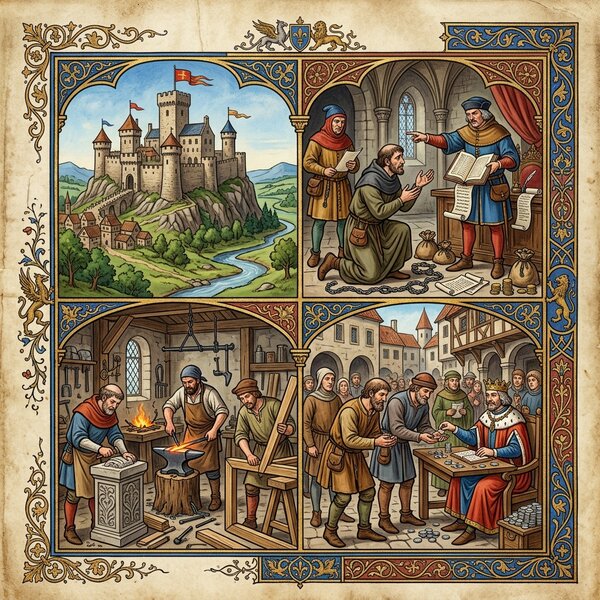

Imagine you are lying in bed in the year 1350 with a high fever – and your doctor recommends opening a vein so that the supposedly ‘corrupted blood’ can flow out. Welcome to medieval medicine, an era in which the line between medicine and superstition was blurred. What doctors actually recommended back then often sounds unbelievable today – and was not infrequently life-threatening.

What you can expect in this article
- Key findings at a glance
- Between faith, superstition and the theory of the four humours: the framework of medieval medicine
- The theory of the four bodily humours: why bloodletting and cupping seemed ‘logical’
- Bloodletting, cupping & co.: standard treatments with dangerous side effects
- Mercury: the supposed panacea with deadly side effects
- Bizarre remedies for the plague: incense, foul odours and exotic ingredients
- The plague doctors and their beaked masks: between symbolism and protection
- Magical rituals, amulets and relics: when medicine and religion merge
- Monastic medicine: between the herb garden and surprisingly modern pharmacology
- Surgery, bath attendants and barbers: when a haircut ended in an operation
- Hygiene, textiles and the first quarantines: effective but poorly understood measures
- Enemas and tobacco: cleansing from within
- Between error and the precursors of modern medicine: what we can learn today from medieval medicine
- FAQ: Frequently asked questions about curious healing methods of the Middle Ages
 Reading time approx. 13 mins.
Key findings at a glance
- The theory of humours as a foundation: Medieval medicine was based on the ancient theory of humours, according to which illnesses were regarded as an imbalance of the four bodily humours: blood, phlegm, yellow bile and black bile. Almost all therapies were derived from this theory.
- Dangerous misconceptions alongside genuine benefits: Excessive bloodletting, mercury treatments and magical rituals stood alongside effective approaches – monastic medicine with herb gardens, early quarantine measures and empirical wound care were proven to save lives.
- A blend of observation and belief: the Church, astrology and folk beliefs influenced treatment and diagnosis just as much as practical experience.
- Plants that remain effective to this day: Remedies such as willow bark and marigold have proven healing properties that have been confirmed by modern studies.
- A lesson for today: the history of these methods shows why evidence-based science and systematic research are indispensable for distinguishing error from genuine knowledge.
Between faith, superstition and humoral theory: the framework of medieval medicine
Medical knowledge between the 9th and 15th centuries rested on three pillars: the ancient authors Hippocrates and Galen, the Arab-Islamic scholarly tradition, and the teachings of the Church. These sources formed the foundation upon which every physician built their expertise.
Central to this was humoral pathology – the doctrine of the four bodily humours: blood, phlegm, yellow bile and black bile. Health meant a balance of these humours; illness, their imbalance. Every person possessed an individual mix of these humours, influenced by age, gender, the season and the climate.
This worldview permeated the entire era: illness was regarded not only as physical suffering, but often also as a divine test or punishment for a sinful way of life. The Church dominated thought, and the anointing of the sick was, in practice, regarded as equally valid alongside herbal remedies.
The social divide amongst practitioners of medicine was enormous. In cities such as Salerno, Bologna and Paris, university-trained physicians practised, having studied specialist Latin literature and ancient texts. In the countryside, however, barbers, midwives and so-called herbalists took charge of caring for the population – often without formal training, but with local experience and knowledge passed down through the generations.
The theory of the four bodily humours: why bloodletting and cupping seemed ‘logical’
As a system of thought, the theory of the four humours was far more coherent than it appears from today’s perspective. Each of the four humours corresponded to a temperament and an element:
- Blood → sanguine → Air (warm, moist)
- Phlegm → phlegmatic → water (cold, moist)
- Yellow bile → choleric → fire (warm, dry)
- Black bile → melancholic → Earth (cold, dry)
Diagnosis followed fixed rules. Uroscopy was a common method: doctors examined the colour, smell and consistency of the urine to draw conclusions about the state of the humours. In addition, taking the pulse, observing the skin and assessing the patient’s state of mind were standard practice.
Physicians derived their treatments from these findings: fever was regarded as an excess of ‘heat’ and was treated with cooling diets and bloodletting; phlegm with emetics and purgatives; and melancholy with dietary changes and mild purgative measures.
Astrological beliefs also influenced treatment: certain procedures were only permitted on days deemed favourable according to the phase of the moon and the constellations. This link between astrology and medicine persisted well into the Renaissance.
The theory persisted for so long because it was theologically grounded, appeared plausible and had no experimental alternative. In his decades of research into the history of medieval medicine, the Würzburg-based medical historian Gundolf Keil has repeatedly highlighted the extent to which the theory of humours formed the intellectual framework of medical education in Europe for centuries.
Bloodletting, cupping & co.: standard therapies with dangerous side effects
Europe around 1350: A doctor leans over his patient, who lies in bed with swollen lymph nodes and a fever. He consults his bloodletting calendar, checks the phase of the moon and reaches for the lancet.
Bloodletting had been practised since antiquity and was the most commonly recommended treatment for almost two millennia. Doctors chose the day, the part of the body and the amount of blood to be drawn according to astrological tables.
The risks were considerable:
- In patients who were already weakened, bloodletting often led to serious complications and even death.
- Instruments were rarely sterilised, and wound infections were common.
- Even into the early 20th century, bloodletting was still recommended as a treatment – for conditions such as high blood pressure, for example.
A famous example: in 1799, whilst suffering from a severe throat infection, the American founding father George Washington lost around 2,365 millilitres of blood in the course of a single day through several successive bloodlettings – a volume of blood loss that presumably hastened his death.
In addition to bloodletting, other methods were used. Cupping was used to drain excess bodily fluids, whilst leeches were employed to draw blood and promote healing. Both procedures followed the same humoral logic.
Mercury: the supposed panacea with deadly side effects
No less dangerous was the use of mercury. From the early 16th century onwards, doctors used mercury vapours to treat syphilis; later, rubs were added to the treatment, and by the 19th century, oral administration had also become common practice. Mercury remained in widespread use until 1943 – the year in which penicillin proved to be an effective treatment for syphilis. The treatment frequently led to heavy metal poisoning and death. The old saying ‘A night with Venus, a lifetime with Mercury’ sums up the dilemma: the supposed cure was often worse than the disease.
Bizarre remedies for the plague: incense, foul odours and exotic ingredients
The Black Death (1347–1353) killed an estimated third of the European population. Fear drove people and healers to desperate measures. The treatises on the plague from that period contain recommendations that seem hardly credible from today’s perspective.
Theriac was regarded as a universal remedy and consisted of many ingredients – sometimes over 60 different substances, including aromatic compounds, roots, spices and powdered gemstones. Those who could not afford theriac resorted to simpler recipes:
- mixtures of vinegar and wine to drink, to combat ‘internal decay’
- Incense made from juniper, frankincense and myrrh to purify ‘plagued air’
- Dried toad powder or burnt snake parts to rub onto the skin – based on the belief that poison must be countered with an antidote
- Dried excrement from various animals used as poultices or incense
Animal-derived ingredients were routinely included in remedies, and many of these recipes were documented in municipal regulations and medical reports – for example, in the well-known report by the Paris Faculty of Medicine from 1348. These historical accounts show that even respected European physicians recommended such methods.
Most recommendations were underpinned by a logic based on humoral theory: strong odours were thought to dispel the ‘miasmas’ – toxic vapours – which were believed to be the cause of epidemics. Some resins and spices did indeed have an antibacterial effect, but most recipes were either neutral or harmful.

The plague doctors and their beaked masks: between symbolism and protection

Strictly speaking, the iconic plague mask with its long beak, familiar from countless images, actually dates from the early modern period. The French physician Charles Delorme designed it around 1619, yet it ties in directly with the miasmatic theory of the late Middle Ages.
The typical kit comprised:
- a beaked mask, filled with herbs, vinegar-soaked sponges, cloves or juniper
- a wax-soaked cloak, intended to repel bodily fluids
- gloves and a wide-brimmed hat to act as a barrier
- a long staff for examining patients without having to touch them directly
In contemporary depictions, the figure appears ghostly – and indeed, it tended to instil fear rather than confidence in the general public. Despite the flawed theory, the equipment did offer a certain degree of practical protection: the clothing and the herb-filled beak formed a primitive barrier against droplet infection and direct contact with bodily fluids.
Magical rituals, amulets and relics: when medicine and religion merge
For most people in the Middle Ages, the boundary between medicine, faith and magic was barely discernible. Anyone who fell ill sought help from anything that promised a cure – whether it was a relic, a plant or a ritual.
- Amulets inscribed with psalm verses, animal teeth or gemstones, worn on the body as protection against illness
- The cult of relics: fragments of bone or the clothing of saints, to whom supernatural healing powers were attributed
- Pilgrimages to holy springs and sites of relics, often covering hundreds of kilometres
- Exorcisms and incantations against supposed ‘demonic’ illnesses such as epilepsy or severe melancholy
Some people attempted to transfer their illness to an animal through so-called ‘sympathy spells’ – a practice that had little to do with official church rites but was widespread in everyday life. The Church itself offered its own healing rituals: the anointing of the sick, intercessory prayers and spiritual guidance were regarded as recognised components of pastoral care. This close intertwining of religion and medicine was, as described in Gundolf Keil’s research on the history of medieval medicine, not a contradiction, but the logical consequence of a world in which illness was understood as an expression of divine will.
Monastic medicine: between the herb garden and surprisingly modern pharmacology


Monasteries were the hospitals of the Early and High Middle Ages. The Rule of Saint Benedict obliged monks and nuns to care for the sick, and many monastic houses maintained their own infirmaries and systematically laid-out herb gardens.
The plan of St Gallen Abbey (c. 820) and Charlemagne’s *Capitulare de villis* (c. 800) demonstrate how medicinal plants were cultivated in a targeted manner. Among the most frequently used herbs were:
| Plant | Use at the time | Modern classification |
|---|---|---|
| Sage | Inflammation, mouthwashes | Proven anti-inflammatory effect |
| Calendula | Wound healing | Calendula in modern wound ointments |
| Fennel | Digestive complaints | Also an ingredient in gastrointestinal teas |
| Comfrey | Fractures, bruises | External use in phytotherapy |
Willow bark has been shown to have healing properties – it contains salicin, the precursor to modern aspirin. Hildegard von Bingen (1098–1179) described hundreds of herbal remedies in her works *Physica* and *Causae et curae*, including marigold, the medicinal use of which had scarcely been documented in this form prior to her time. Modern studies have shown that many of her accounts described historically plausible applications.
Despite its religious character, monastic medicine was surprisingly empirical. Monks and nuns observed, documented and passed on their recipes in herbariums and pharmacopoeias. Some even used mouldy bread and honey to treat wounds – primitive precursors to antibiotic therapies, centuries before penicillin was discovered.
Surgery, bath attendants and barbers: when a haircut ended in an operation
Whilst university medicine focused primarily on theory, practical surgical work was in the hands of barbers and bath attendants. In the medieval bathhouse, one would sit on a wooden stool, have a shave – and could then immediately have bloodletting, a tooth extraction or the removal of an arrowhead carried out.
Typical procedures included:
- Tooth extraction using crude pliers – without any form of anaesthesia
- Amputations using a saw, followed by cauterisation of the wound
- the application of leeches and cupping glasses
- Treating battle and accident wounds
Even more radical were skull operations: trepanation – the drilling of a hole in the skull – is considered one of the oldest surgical procedures in existence. More than 1,500 trepanated skulls from the Neolithic period are known worldwide today, a significant proportion of which come from Europe; some estimates suggest that up to 5 to 10 per cent of all Neolithic skull finds show signs of trepanation. Neolithic surgeons used stone knives to open the skull. Trepanations were used, amongst other things, to treat cerebral haemorrhages, though the exact intentions behind them are often unclear and a matter of speculation – some researchers also suspect ritual motives. The fact that a variant of this practice, the lobotomy, was still being performed as late as the 20th century demonstrates just how far-reaching the legacy of such cranial operations is.
Academic surgery gradually developed from these practices during the late Middle Ages and the Renaissance. In the 14th century, Guy de Chauliac wrote one of the first systematic surgical textbooks. To this day, the red-and-white barber’s column serves as a reminder of the link between personal hygiene and medicine – red for blood, white for dressings.
Hygiene, textiles and the first quarantines: effective but poorly understood measures
Medieval towns provided ideal conditions for epidemics: dense housing, open sewage channels, animals and rubbish in the alleys. Outbreaks of disease were explained as being caused by ‘miasmas’ – toxic vapours from decaying matter – or by divine punishment.
Nevertheless, effective measures emerged, even without an understanding of bacteria or viruses:
- Textiles and clothing belonging to the sick were washed separately, boiled or burnt – an early form of infection control
- Infected people were isolated: houses and neighbourhoods were cordoned off in the event of the plague or leprosy
- In Venice, the term ‘quaranta giorni’ emerged in the 14th century: ships had to wait 40 days off the harbour before being allowed to enter
These quarantine measures were among the few truly effective methods against the spread of the plague, even though the actual pathogens – bacteria transmitted by fleas – were unknown. At the same time, the authorities placed fragrant incense burners in the streets – ineffective, but intended as a call to the population to ‘purify the air’.
Enemas and tobacco: cleansing from within
Enemas were used to cleanse the body and treat various ailments – the aim was to flush ‘corrupted humours’ from the bowels. This practice reached curious extremes in modern times: tobacco enemas became popular in the 18th century and were intended to resuscitate drowning victims and stimulate blood circulation. The Royal Humane Society, founded in London in 1774, installed special resuscitation devices, complete with bellows, at public locations along the Thames so that first aiders could use them immediately in cases of near-drowning. It was not until the 19th century that the method began to be viewed with increasing scepticism, when it was realised that nicotine is toxic – the death knell for one of the strangest medical practices in history.
Between error and the forerunner of modern medicine: what we can learn today from medieval medicine
An overview of medieval healing methods reveals a paradox: the very same era that gave rise to magical rituals and excessive bloodletting also developed effective quarantine measures, systematic herbal medicine and fundamental anatomical knowledge.
Empirical observation worked thanks to generations of experience – even without a theory of microbes. Wound cleansing, the isolation of the sick and certain herbal preparations saved lives, even if the underlying reasoning was flawed.
Erroneous theories such as the theory of humours nevertheless formed an important bridge between ancient and modern medicine. They fostered systematic reflection on the causes of disease and treatments – a framework that was only superseded by the germ theory in the 19th century and modern laboratory science.
What often distinguished quacks and charlatans from genuine medical practitioners was not so much their knowledge as their willingness to subject it to critical scrutiny. The history of medicine teaches us that tradition and authority alone offer no guarantee of effectiveness. Anyone who smiles at the curious healing methods of the Middle Ages should ponder this question: which of our current practices will future generations view with equal bewilderment?
FAQ: Frequently asked questions about the curious healing methods of the Middle Ages
Were medieval doctors really just quacks?
Not at all. There were certainly well-trained physicians who studied at universities such as Salerno, Bologna or Paris. They were fluent in Latin, read Galen and Avicenna in the original and practised according to the best scientific knowledge of the time. Their diagnoses – for example, through uroscopy or pulse-taking – followed a systematic methodology. However, from today’s perspective, the underlying theories were incorrect. The distinction between the educated physician and the local quack was already recognised in the Middle Ages and was socially significant.
Were there hospitals in the Middle Ages?
Yes, hospitals and infirmaries had existed since the early Middle Ages, mostly run by the Church. However, these were more like care homes than medical institutions in the modern sense: they provided the poor, pilgrims, the elderly and the sick with accommodation, food, care and spiritual support. Monastic infirmaries supplemented this care with herbal medicine and simple surgical procedures.
What role did women play in medieval medicine?
Women were active as midwives, herbalists and, in monasteries, as nuns in nursing and medicine. Hildegard von Bingen is the best-known example, but by no means the only one. Despite legal restrictions and increasing exclusion from universities, women had a decisive influence, particularly in the fields of obstetrics and home nursing.
Which medicinal plants from monastic medicine are still used today?
Specific examples include St John’s wort (which lifts the mood in cases of mild low mood), valerian (calming and sleep-inducing), sage (anti-inflammatory in the mouth and throat), marigold (wound healing) and monk’s pepper (hormonal regulation). Their effects have been partially confirmed by clinical trials, whilst further research is still ongoing in some cases.
When did the shift away from the traditional healing methods of the Middle Ages begin?
The shift began in the early modern period, when anatomical dissections in the 16th century – led above all by Andreas Vesalius – provided the first precise descriptions of the anatomy of the human body. However, the real turning point for the theory of humours came in the 19th century with Pasteur and Koch’s germ theory, the introduction of anaesthesia and antisepsis, and the rise of laboratory sciences. It was only then that bloodletting, magical rituals and mercury treatments were gradually replaced by evidence-based medicine.


Letters from the trading house
New arrivals, market dates and offers, straight from Rinchnach. Unsubscribe any time with one click.
Subscribe to the newsletter